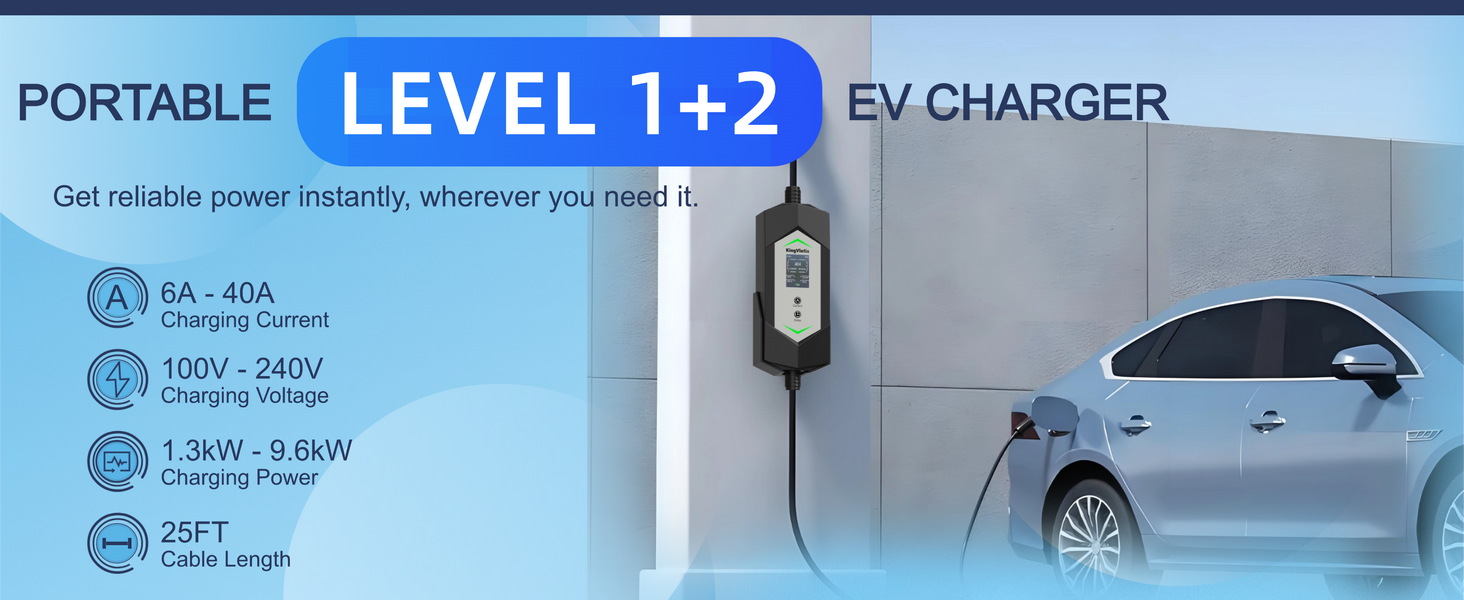
A 40A portable EV charger with a 25ft cable sits at the top of the portable class: it delivers up to 9.6 kW on a NEMA 14-50 outlet, roughly 30 or more miles of range per hour, while the long cable and dual J1772 plus Tesla NACS support mean it reaches almost any parking spot and any EV. This review breaks down what this spec class offers, the real-world speeds, who it fits best, outlet and breaker needs, and which verified unit we recommend. If you want wall-charger speed without a wall, this is the category to shop.
The defining traits are a 40A output, a 25ft cable, and a NEMA 14-50 plug for RV-park and pedestal use, often with a NEMA 5-15 adapter for slow 120V fallback. The standout feature is connector coverage: a J1772 plug for every non-Tesla EV plus a Tesla NACS adapter (or native NACS on some models) for Teslas. That combination means one box serves a two-EV household with different connectors. For the reference unit in this class, the MACH 3 40A portable on Amazon carries both J1772 and native NACS.
| Plug | Power | Range / hour |
|---|---|---|
| 5-15 (120V) | 1.92 kW | ~6 to 7 mi |
| 6-20 (240V, 16A) | 3.84 kW | ~13 to 15 mi |
| 14-50 (240V, 40A) | 9.6 kW | ~30+ mi |
On a 14-50, a 40A unit adds 30-plus miles per hour, near wall-charger speed. The 25ft cable lets you reach pedestals and awkward parking without strain.
Among 40A portables, the MACH 3 40A is the cleanest choice because it ships with both a J1772 connector and a native Tesla NACS connector, so a Tesla needs no adapter on the car side and a J1772 car needs none either. It runs on NEMA 14-50, pushes 9.6 kW, and carries a 25 ft cable. See the MACH 3 40A portable on Amazon. If you instead want a J1772-only unit, a Tesla driver adds a Tesla NACS adapter; a J1772 car at a Tesla Destination uses a Tesla-to-J1772 adapter.
| Option | Speed | Portable? | Install |
|---|---|---|---|
| 40A portable | ~30+ mi/hr | Yes | Outlet only |
| Wall charger 48A | ~40 mi/hr | No | Hardwired |
A wall charger is marginally faster and tidier for one fixed home; a 40A portable delivers nearly the same speed and goes with you. Our home charger roundup compares the leaders.
Insist on a certified unit (UL or ETL) with over-current, over-temperature, ground-fault, and surge protection. Keep the control box dry and off hot pavement, and never extend the charger with a household cord. Our safety guide covers the basics.
A 40A draw generates more heat in the cabling, so thermal care matters more than at 16A. In freezing weather, the car’s battery accepts current more slowly until it warms, so early sessions may start gently. In extreme heat, the control box may throttle, which is normal and safe. Keep the brick out of direct sun, store it indoors, and wipe the connector before plugging in. A weather-rated unit survives rain and snow.
Electricity cost is unchanged, about $0.16/kWh, so a 75 kWh fill is roughly $12. The 40A portable just delivers that energy faster wherever a 14-50 exists. Our cost guide runs the numbers. Over a year of travel, portable charging beats public fast charging on price.
If a session ends early, check the car or app for a fault code, then confirm the 14-50 outlet is powered and the plug is seated. A loose or dirty connection is the top cause; unplug, wait ten seconds, reseat both ends. If the brick is hot, move it to shade, since throttling is normal. Repeating failures on a known-good outlet may mean service is needed. Certified portables fail safe, and a reset resolves most non-issues.
Coil the 25 ft cable in loose loops, keep connectors dry, and wipe the plug clean before storage. Inspect the jacket monthly for cuts. Store indoors between trips; a cared-for 40A portable lasts years and remains a dependable backup even after you install a wall charger.
A 40A portable with a 25ft cable and J1772 plus Tesla NACS support is the most capable mobile charger you can buy, delivering near wall-charger speed anywhere a 14-50 exists. Our pick is the MACH 3 40A for its native dual connectors and 9.6 kW output. Match it to a dedicated 50A outlet, keep it certified, and you get fast, flexible charging for road trips, cabins, and backup alike.
When you shop a 40A portable, four checks separate a safe unit from a risky one. First, certification: look for UL or ETL listed on the box, not just a claim buried in the listing. Second, connector coverage: a unit with both J1772 and native NACS saves you adapters and the failure points they introduce. Third, cable length: 25ft reaches RV pedestals and awkward stalls where a 16ft cable would force a bad parking angle. Fourth, the control box: it should show status lights and shut down on fault rather than overheat. Read the label amperage and confirm it matches a 50A breaker before you buy, and you will avoid the most common, and most dangerous, mismatch.
A 40A portable is not a Supercharger replacement, but it changes how you travel. DC fast charging gives 150 to 250 miles in twenty minutes at a cost of roughly $0.35 to $0.50 per kWh, while your 40A portable on a 14-50 pedestal adds 30-plus miles per hour at home or campsite rates, often under $0.20 per kWh. For overnight stops, the portable wins on price and convenience; for a mid-day sprint, a DC station wins on speed. Many road-trippers carry both: the portable for the cabin and the DC network for the highway. The portable also removes range anxiety at rentals and friends’ houses where no fast charger is nearby.
A 40A portable gets handled, dropped, and rained on more than a wall unit, so plan for wear. Coil the cable in loose loops to avoid kinking the conductors, wipe the connectors before storage, and keep the control box out of standing water. Check the NEMA 14-50 plug prongs for heat discoloration after a long session; slight warmth is normal, melting is not. A 40A draw is unforgiving of bad wiring, so never use adapters to force a wrong outlet. With basic care, a certified 40A portable stays reliable for years and remains a useful backup even after you install a permanent wall charger, which is exactly why seasoned EV owners keep one in the trunk.
Picture a long weekend at a lakeside cabin reached by a narrow road with no fast charger for sixty miles. You arrive at 30 percent, plug the 40A NACS portable into the cabin’s 14-50 pedestal, and by morning you have added 200-plus miles while you slept, for the price of the cabin’s electricity. The next day’s sightseeing needs no charging plan at all. Without the portable, that same trip means a detour to a busy DC station and a half-hour wait. This is the quiet advantage of carrying near wall-charger speed in the trunk: freedom from the public network, on your own schedule, at a fraction of the cost.
Lorem Ipsum is simply dummy text of the printing and typesetting industry
Complete guide to EV charger load management: dynamic load balancing, power sharing, static allocation. Wallbox, Autel, Emporia. Avoid panel upgrades...
Best Level 1 EV chargers for 120V outlet charging. Lectron dual-voltage, Tesla Mobile Connector, Emporia. Tips, costs, safety, when to...
Complete guide to scheduling EV charging: TOU rates, smart charger apps, solar surplus charging, cost savings calculator. Emporia, Wallbox, ChargePoint...




