
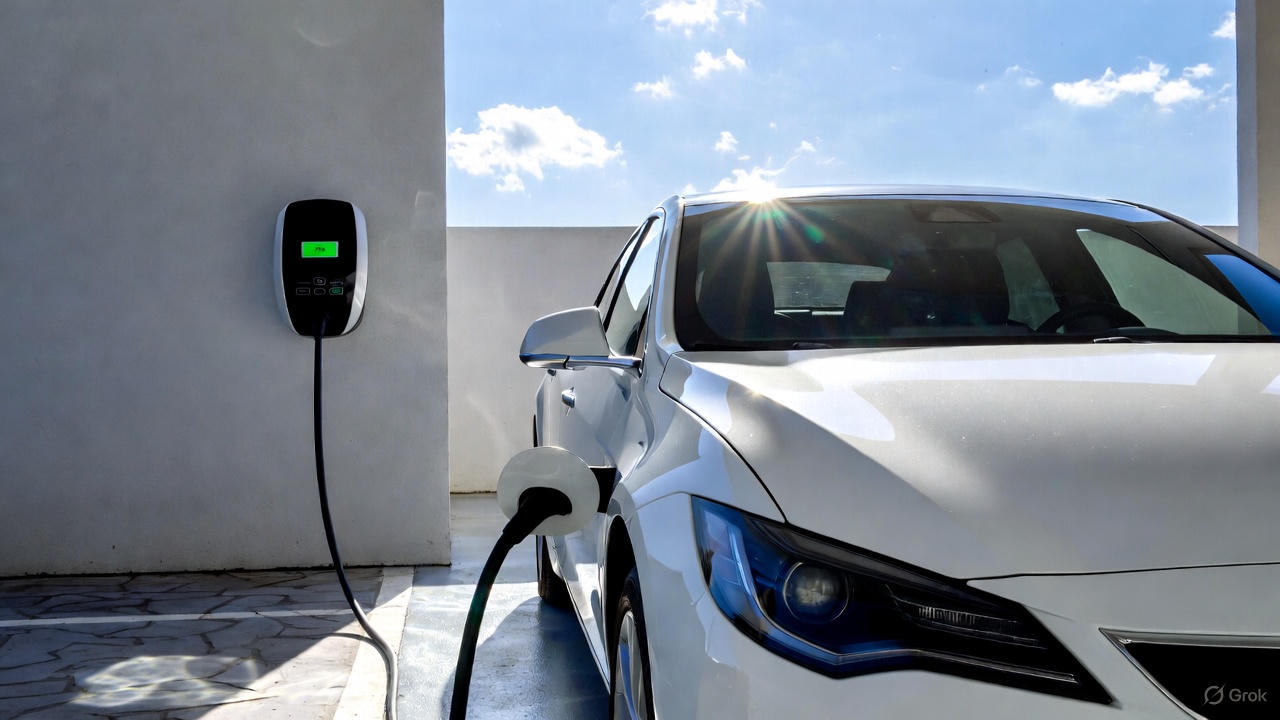
A practical guide to EV charging methods, speed, power requirements, and what to consider before buying or installing charging equipment.
Most EV charging equipment falls into three categories: Level 1, Level 2, and DC Fast Charging (often called Level 3). They differ in voltage, power, speed, and installation complexity.
| Charger type | Typical input | Typical power output | Best use | Practical speed (typical) |
|---|---|---|---|---|
| Level 1 (AC) | 110–120V AC (U.S.) | ~1–2 kW continuous | Backup / low daily mileage | ~3–6 miles of range per hour |
| Level 2 (AC) | 220–240V AC | ~3–19 kW (often adjustable) | Home overnight charging, workplaces, destination charging | Often ~20–40 miles of range per hour (vehicle-dependent) |
| DC Fast Charging | High-voltage DC equipment + commercial supply | 50 kW to 350 kW+ (site-dependent) | Road trips, high-turnover public sites | Commonly 10–80% in ~20–40 minutes (vehicle + charger dependent) |
Note: Charging speed varies by vehicle efficiency, battery temperature, state of charge, and your vehicle’s onboard limits.
When buyers compare chargers, they often focus on “maximum kW.” In practice, charging speed is limited by:
Level 1 uses a standard household outlet (110–120V in the U.S.). Many EVs include a Level 1 charging cable in the box. It is slow, but can be sufficient for drivers with shorter daily commutes.
A common real-world range is about 3.5 to 6.5 miles of range per hour. This makes Level 1 most suitable as a backup solution or when the vehicle can charge for long uninterrupted periods (overnight or during work hours).
A widely cited cost benchmark for Level 1 non-networked hardware is roughly $596–$813 per charger depending on configuration and context.
Level 2 charging runs on 220–240V and is the most common solution for home overnight charging and workplace charging. It provides a major speed increase without the site-level complexity of DC fast charging.
As a practical planning reference, Level 2 can often fully replenish a ~300-mile EV overnight (often cited as 6–8 hours, depending on the vehicle and charger power).
Incentive program cost reporting shows substantial variability by project type and equipment. For example, CALeVIP cost data for rebated projects reports Level 2 equipment costs per connector ranging from about $685 to $6,626, with an average and median in the ~$2,900–$3,000 band. (This is not a retail price tag—this is reported project cost context and varies by site and scope.)
Modern DC fast charging can often add large amounts of energy quickly—commonly referenced as charging from 10% to 80% in roughly 20–40 minutes, depending on vehicle capability and charger power.
DC fast chargers typically require commercial-grade electrical service. Some program guidance notes minimums like 480V and high current requirements, and newer systems can be higher voltage and higher power.
CALeVIP cost data analysis reports a wide cost range for rebated DC fast chargers, from about $18,000 to $72,500 per charger, with a mean of $29,135 and a median of $23,000 in their dataset.
With many charger models and price points on the market, use this decision framework:
Many regions offer incentives to reduce purchase and installation cost. Typically, you should check:
In California, for example, CALeVIP provides incentives for eligible Level 2 and DC fast chargers in certain regions and projects.
In North America, Level 2 is typically 240V AC. In many other regions, the household supply is already ~230V, but “Level 2” still refers to higher-power AC charging equipment rather than basic outlet charging.
Not all EVs support DC fast charging, and connector standards vary by region and vehicle. Always verify your vehicle’s DC capability and connector type.
Not necessarily. If your EV cannot accept the higher rate—or if your home panel cannot support it—the extra rated power may not translate into faster charging.
Disclaimer: This article provides general educational guidance. Always follow manufacturer instructions and consult a qualified electrician for installation decisions.
Lorem Ipsum is simply dummy text of the printing and typesetting industry
Complete guide to EV charger load management: dynamic load balancing, power sharing, static allocation. Wallbox, Autel, Emporia. Avoid panel upgrades...
Best Level 1 EV chargers for 120V outlet charging. Lectron dual-voltage, Tesla Mobile Connector, Emporia. Tips, costs, safety, when to...
Complete guide to scheduling EV charging: TOU rates, smart charger apps, solar surplus charging, cost savings calculator. Emporia, Wallbox, ChargePoint...




