
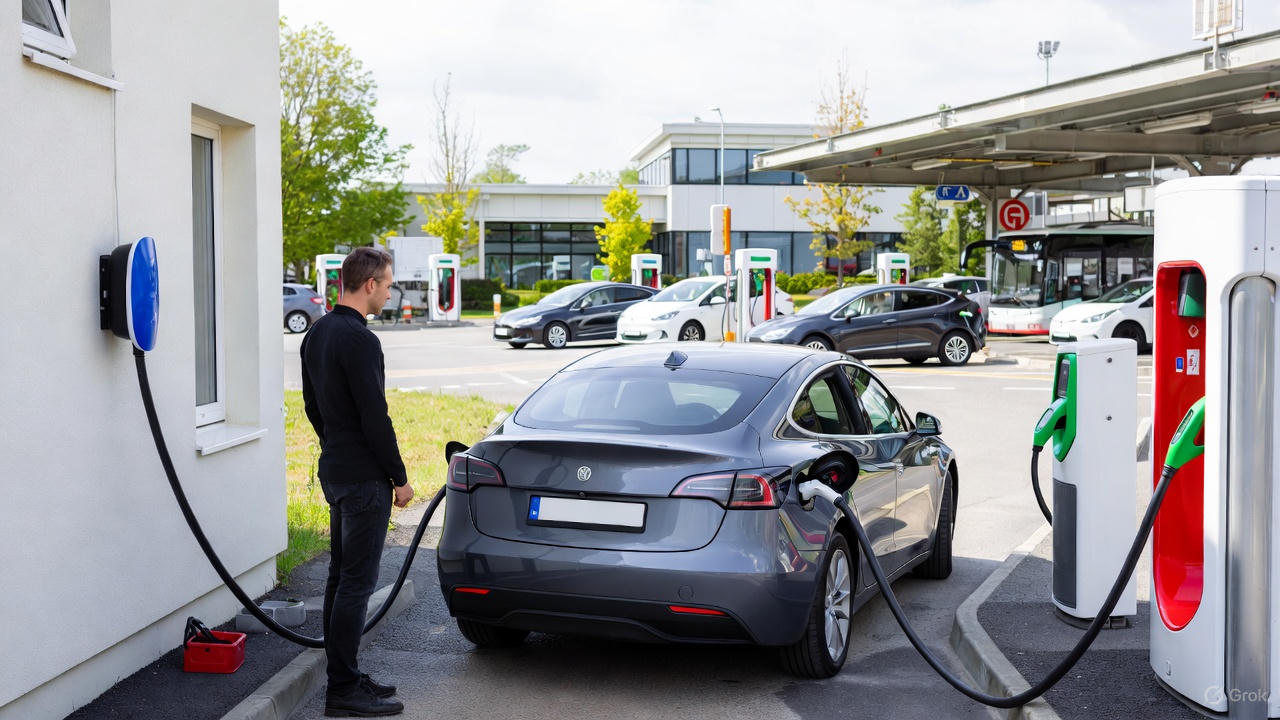
Whether you already own an electric vehicle or are just beginning to explore EVs, this page answers the most common questions about electric vehicles and charging. From basic concepts to the key factors that affect charging speed, this guide is designed to help you build a clear and practical understanding of EV charging.
Electric vehicles generally fall into three main categories:
In everyday conversation, the term “electric vehicle” most commonly refers to Battery Electric Vehicles (BEVs).
Charging an electric vehicle is more similar to charging a smartphone than refueling a gas car. EV owners can charge at home, at work, or at public charging stations, and they do not need to wait until the battery is nearly empty to plug in.
EV charging generally takes longer than filling a gas tank. However, with modern DC fast charging, many vehicles can regain a significant amount of range in as little as 15–45 minutes under the right conditions.
Battery electric vehicles produce zero tailpipe emissions while driving. Even when electricity generation is considered, EVs typically produce fewer overall emissions than gasoline vehicles.
As power grids continue to incorporate more renewable energy, the environmental benefits of EVs are expected to increase further.
In many regions, charging an electric vehicle costs less than refueling a gasoline car. Electricity prices vary by time of use, and charging during off-peak hours can further reduce operating costs.
Just as electrical outlets vary between countries, EV charging connectors also differ by region and manufacturer.
Knowing which connector your vehicle supports is essential for ensuring compatibility and efficient charging.
An EV charging adapter allows a vehicle to connect to a charging station that uses a different connector standard. Adapters do not supply power themselves; they simply enable compatibility.
Because adapters add an extra connection point, they can introduce additional safety and reliability considerations. Only certified, vehicle-approved adapters should be used.
Charging time depends on several factors, including:
Many EV owners complete most of their charging at home or at work, allowing the vehicle to recharge while parked for extended periods.
EV charging can be compared to water flowing through a pipe:
Charging is usually fastest when the battery is at a lower state of charge. As the battery fills, the vehicle gradually reduces charging power to protect battery health.
Actual charging speed is limited by the lower capability of either the vehicle or the charging station. A higher-power charger will not increase speed if the vehicle cannot accept it.
Batteries charge more slowly in very hot or very cold conditions. Battery management systems reduce charging power to prevent damage under extreme temperatures.
EV batteries consist of hundreds or thousands of individual cells. When the battery is low, it is easy for energy to enter the cells. As the battery fills, available space decreases and charging naturally slows.
Around 80% state of charge, most vehicles significantly reduce charging speed. This behavior is normal and helps extend battery lifespan.
A vehicle’s advertised maximum charging power is not sustained continuously. The battery management system dynamically adjusts charging based on temperature, battery condition, and state of charge.
This intelligent control ensures long-term safety and durability, even if it means charging more slowly at certain times.
In summary: Slower charging speeds are usually a sign of proper battery protection, not a problem with your vehicle or charging equipment.
Lorem Ipsum is simply dummy text of the printing and typesetting industry
Complete guide to EV charger load management: dynamic load balancing, power sharing, static allocation. Wallbox, Autel, Emporia. Avoid panel upgrades...
Best Level 1 EV chargers for 120V outlet charging. Lectron dual-voltage, Tesla Mobile Connector, Emporia. Tips, costs, safety, when to...
Complete guide to scheduling EV charging: TOU rates, smart charger apps, solar surplus charging, cost savings calculator. Emporia, Wallbox, ChargePoint...




