
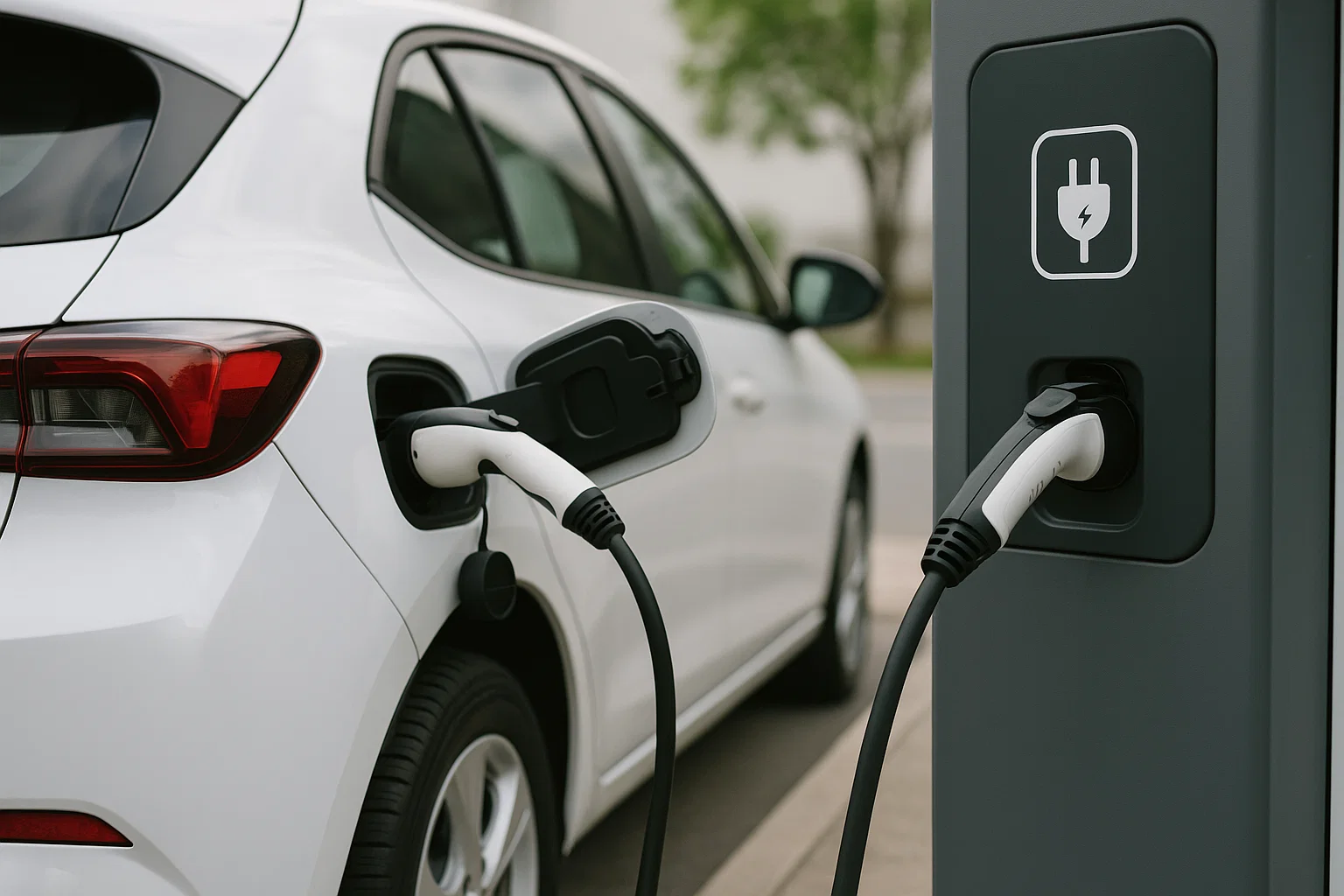
This guide answers the most common — and most important — questions about EV charging, installation costs, home electrical requirements, battery health, charging levels, and long-term EV ownership. All answers are written to be practical, professional, and easy to understand.
🔌 View Recommended EV Chargers on AmazonHome installation typically costs $300–$1,200 depending on distance from the electrical panel, wiring upgrades, and local electrician rates. If a panel upgrade is required, costs can reach $2,000–$4,000. Most homeowners fall in the $500–$900 range.
Installing a 240V NEMA outlet (14-50 or 6-20) usually costs $250–$500 if the panel is nearby. Long conduit runs or drywall work may push it to $600–$900.
Yes — any licensed electrician can install a Level 2 EV charger. EV-specific certification is not required, but experience with high-load circuits (>40A) is recommended.
Yes. The U.S. Federal EV charger tax credit (30C) covers 30% of the cost up to $1,000 for qualifying home installations. Some states add extra rebates.
A home with a 100A panel can usually support a 32A charger, while a 150–200A panel supports 40A–48A chargers. A load calculation is required to ensure safety.
Yes — typically 60–75% cheaper. Charging at home averages $0.03–$0.05 per mile versus gasoline at $0.12–$0.20 per mile.
You can plug in a NEMA 14-50 or 6-20 plug-in charger yourself, but hardwired chargers and outlet installations must be done by a licensed electrician to meet code and insurance requirements.
For daily driving, experts recommend charging to 80% to reduce battery stress and maximize lifespan. Charge to 100% only for road trips.
Most EVs retain 80–90% battery capacity after 5 years. Modern lithium batteries degrade slowly, typically losing 1.5–2.5% capacity per year.
Some are, especially at malls, workplaces, and hotels. However, many “free” chargers eventually switch to pay-per-use models as demand increases.
Yes — home charging is cheaper, more convenient, and significantly faster than Level 1. It also increases home resale value in EV-heavy markets.
Ideally:
Garages are ideal, but outdoor installation is safe with NEMA 4/IP66 chargers.
Level 3 is faster, but not “better” for daily use. Frequent DC fast charging accelerates battery wear. Level 2 is recommended for home use.
Home charging is usually 50–70% cheaper than public charging. DC fast charging is the most expensive.
Most home chargers last 8–12 years, with high-quality units lasting up to 15 years.
Level 2 is typically 5–8 times faster than Level 1.
The cost per kWh is identical. Level 2 is simply faster — not more expensive per mile.
Tesla’s Mobile Connector is Level 1, while the Tesla Wall Connector is Level 2 and the most popular home charging choice.
Level 3 (DC fast charging) bypasses the onboard charger and delivers up to 350 kW, charging from 10–80% in ~20–30 minutes.
No. Level 3 chargers cost $40,000–$100,000 and require industrial 480V three-phase service.
“Level 4” is not an official standard. Media sometimes use the term for ultra-fast chargers above 350 kW.
220V (Level 2) is significantly better for battery health and convenience. Level 1 is slow and not recommended for daily charging.
High-load appliances: HVAC, water heaters, clothes dryers, and ovens. EV charging adds 10–25% depending on mileage.
Yes, if your EV charger supports NEMA 10-30 or 14-30. Use EV-rated adapters, not generic dryer adapters.
Most EVs use 350–400V battery packs. High-performance EVs (Porsche Taycan, Hyundai Ioniq 5/6) use 800V systems.
Modern EVs range from 220 to 400+ miles depending on model, temperature, and driving style.
No — welding near an EV battery is dangerous and requires special training. EV manufacturers require strict high-voltage safety procedures.
EV motors run on AC. Batteries store DC. The onboard inverter converts DC→AC to drive the motor.
Most EVs can idle with AC/heat for 18–40 hours depending on battery size. EV HVAC systems are extremely efficient.
EVs handle exceptionally well due to:
The only downside is reduced range (~20–30% loss in cold weather).
EV motors typically last 500,000 to 1,000,000 miles — far longer than gasoline engines.
The most common concerns:
Most EV batteries cost $8,000–$20,000. Tesla, Hyundai, and GM packs range from $12,000–$18,000 depending on size.
EVs typically retain 70–80% battery capacity. The vehicle itself often lasts longer than gas cars due to fewer moving parts.
Common reasons:
Yes — absolutely. You will typically need 3–5 fast charging stops. Tesla Superchargers and major networks make long-distance EV travel practical.
Most EV batteries are:
Recycling efficiency is improving rapidly.
Oil is far worse due to continuous extraction, emissions, and pollution. Lithium extraction has environmental impact, but batteries are recyclable and used only once over a car’s lifetime.
Potential candidates:
Solid-state batteries: higher energy density, faster charging, safer, longer lifespan.
Tesla is expanding use of LFP batteries in lower-cost models and experimenting with manganese and high-nickel chemistries.
Solid-state, sodium-ion, and LFP (for cost and longevity) are the most commercially promising.
Top manufacturers ranked for reliability and technology:
Graphene batteries charge faster and run cooler but are not mass-produced for EVs. Lithium remains dominant.
High manufacturing cost, complexity, and lack of large-scale production.
No. Tesla does not use graphene batteries in any production vehicle as of today.
Lorem Ipsum is simply dummy text of the printing and typesetting industry
Complete guide to EV charger load management: dynamic load balancing, power sharing, static allocation. Wallbox, Autel, Emporia. Avoid panel upgrades...
Best Level 1 EV chargers for 120V outlet charging. Lectron dual-voltage, Tesla Mobile Connector, Emporia. Tips, costs, safety, when to...
Complete guide to scheduling EV charging: TOU rates, smart charger apps, solar surplus charging, cost savings calculator. Emporia, Wallbox, ChargePoint...




