
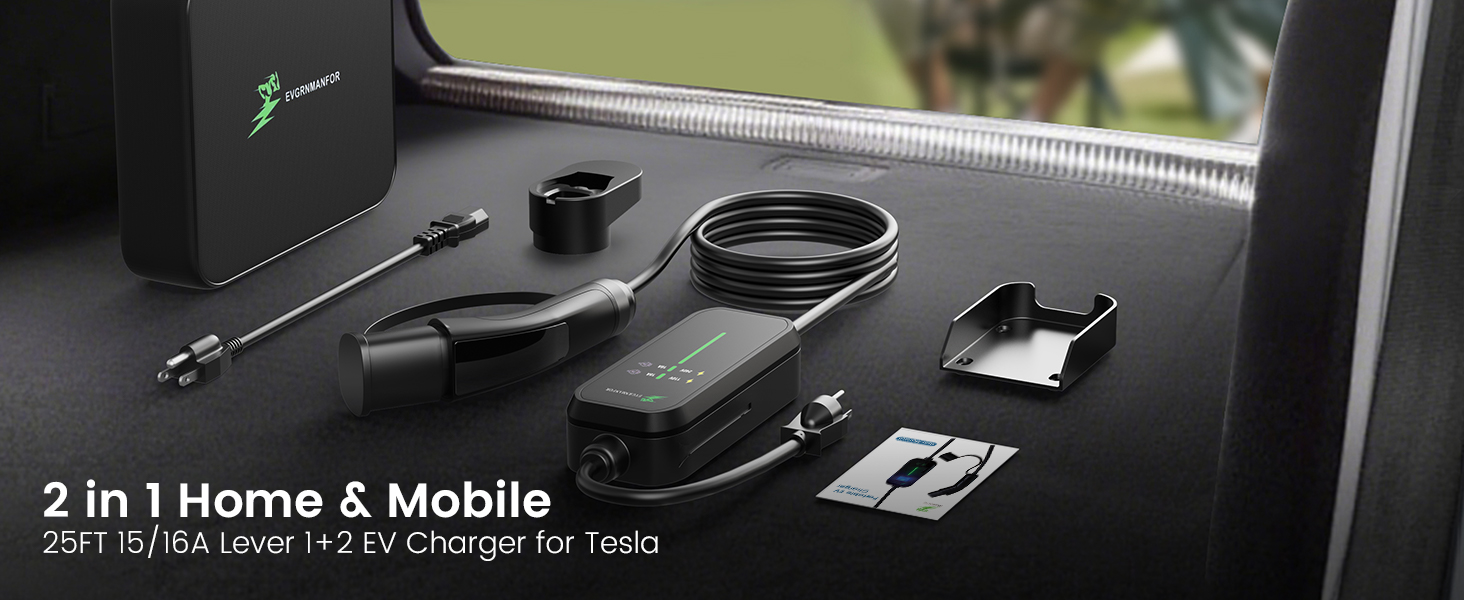
For Tesla owners, a 16A Tesla portable charger with a native NACS connector is the simplest flexible charging: it plugs straight into the car with no adapter, runs off a standard 120V outlet or a 240V outlet for faster charging, and packs in the trunk. The EVGRNMANFOR-class 16A Tesla charger (NEMA 6-20 plus 5-15, 25ft) is a typical example. This review covers native NACS portable charging, real speeds, the Tesla Wall Connector alternative, and our verified Tesla pick.
Tesla’s NACS port is compact and handles both AC and DC, so a Tesla portable with a native NACS connector clicks straight into the car, no adapter on the car side. That simplicity is why many Tesla owners keep a portable as their everyday or travel charger. For a deeper look at the connector, our adapter guide explains NACS versus J1772.
| Plug | Power | Range / hour |
|---|---|---|
| 5-15 (120V) | 1.92 kW | ~6 to 7 mi |
| 6-20 (240V) | 3.84 kW | ~13 to 15 mi |
A 16A Tesla portable adds about 13 to 15 miles per hour on 240V and 6 to 7 on 120V, enough for most daily commuting overnight.
For a fixed home setup, the Tesla Wall Connector Gen 3 is the native, future-proof pick: up to 11.5 kW, Wi-Fi scheduling, power-sharing. See it on Amazon. For portable use, a 16A native-NACS unit or a 40A NACS portable (the MACH 3) covers travel, and a Tesla NACS adapter lets a J1772 portable serve a Tesla. Our Tesla Wall Connector review covers the home anchor.
If you want maximum portable speed, a 40A portable with native NACS (the MACH 3) on a NEMA 14-50 adds 30-plus miles per hour, ideal for trips and RV parks. For everyday light use, a 16A Tesla portable is lighter and cheaper. See the 40A NACS portable and the 16A portable. Our best chargers for Tesla guide helps you choose.
| Option | Speed | Portable? | Install |
|---|---|---|---|
| 16A Tesla portable | ~13 to 15 mi/hr | Yes | None |
| 40A Tesla portable | ~30+ mi/hr | Yes | Outlet only |
| Tesla Wall Connector | ~40 mi/hr | No | Hardwired |
For one fixed home, the Wall Connector is fastest and tidiest. For flexibility, a Tesla portable travels and needs no electrician.
Electricity cost is the same as any home charging, about $0.16/kWh. A Tesla with a 75 kWh pack costs roughly $12 for a full fill. The portable just reaches whatever outlet you have. Our cost guide runs the numbers.
Use only certified Tesla or known-brand portables with proper protections. Keep the connector dry, never use a household extension cord, and store the control box indoors. Our safety guide covers handling.
Imagine a weekend at a cabin with only a NEMA 14-50 pedestal. You plug the 40A NACS portable in, connect it natively, and by morning you have added 200-plus miles. For highway legs you use Superchargers; for the cabin, the portable. A Tesla portable turns almost any outlet into your personal charger, the quiet advantage of NACS-native gear.
Teslas manage cold well, but charging slows when the pack is cold, so early-morning sessions may start gently and speed up as the battery warms. Precondition the battery before a DC fast stop. Keep the NACS connector dry in snow and brush ice off the port before plugging in. Good habits keep both car and charger happy through the seasons.
If charging stops, check the car screen or app for a fault code, then confirm the outlet is powered and the NACS connector is fully seated. A dirty or loose connection is the top cause; unplug, wait ten seconds, reseat, retry. If the brick is hot, move it to shade. Repeated failures may mean service is needed. Certified Tesla gear fails safe, so a reset resolves most minor hitches.
For Tesla owners, a native NACS portable is the most flexible charging you can buy, no adapter on the car side and no electrician required. Use a 16A unit for daily light charging and a 40A NACS portable for road trips and RV parks, and keep the Tesla Wall Connector as your fixed home anchor. Match the plug to your outlet and you have reliable Tesla charging anywhere.
Tesla makes scheduled charging easy, and a portable benefits from it. In the car or app, set charging to start during off-peak hours so you draw cheaper electricity and ease grid load. With a 16A portable on a 120V outlet, scheduling matters less because speed is low, but on a 240V outlet it lets you finish a full charge before morning rates rise. Pair the schedule with a charge limit of 80 to 90 percent for daily use to preserve battery health, and raise it only before long trips. A simple schedule turns an already-flexible portable into a set-and-forget home charger that costs less than you would expect.
Many Tesla owners run a 16A native-NACS portable as their only home charger, especially renters or those with a convenient 240V outlet. It clicks in with no adapter, needs no electrician, and moves with you on moving day. The limit is speed: 13 to 15 miles per hour covers typical commuting but not a two-EV household or high daily mileage. If your routine outgrows it, step up to a 40A NACS portable or a Wall Connector. Treat the portable as a scalable start rather than a compromise you are stuck with, and you keep options open as your driving or housing changes. Flexibility is the whole point of the native-NACS portable design.
Three myths trip up new Tesla owners. First, that a portable is unsafe: a certified native-NACS portable is as safe as any wall unit when used on the right circuit. Second, that you must use only Tesla gear: any J1772 portable plus a quality adapter works fine, and many non-Tesla portables are excellent. Third, that 120V charging harms the battery: it is simply slow; the car manages current safely and protects itself. Knowing these lets you choose the flexible, lower-cost portable path without fear, and reserve the Wall Connector for when you truly need permanent speed. Clear thinking here saves money and avoids needless anxiety about your car’s most-used accessory.
A small charging kit makes a Tesla portable far more useful. Alongside the portable, keep a clean 5-15 to 6-20 adapter, a Tesla NACS adapter for the rare J1772 destination, and a short list of the 14-50 and 6-20 outlets you know. A microfiber cloth keeps the connector dry, and a labeled bag keeps everything together so a passenger can find it. None of this is heavy or expensive, yet it turns a single charger into a complete road kit that handles almost any outlet you meet. Drivers who assemble this kit once stop worrying about where the next charge will come from, which is the real payoff of going portable with a Tesla.
Lorem Ipsum is simply dummy text of the printing and typesetting industry
Complete guide to EV charger load management: dynamic load balancing, power sharing, static allocation. Wallbox, Autel, Emporia. Avoid panel upgrades...
Best Level 1 EV chargers for 120V outlet charging. Lectron dual-voltage, Tesla Mobile Connector, Emporia. Tips, costs, safety, when to...
Complete guide to scheduling EV charging: TOU rates, smart charger apps, solar surplus charging, cost savings calculator. Emporia, Wallbox, ChargePoint...




