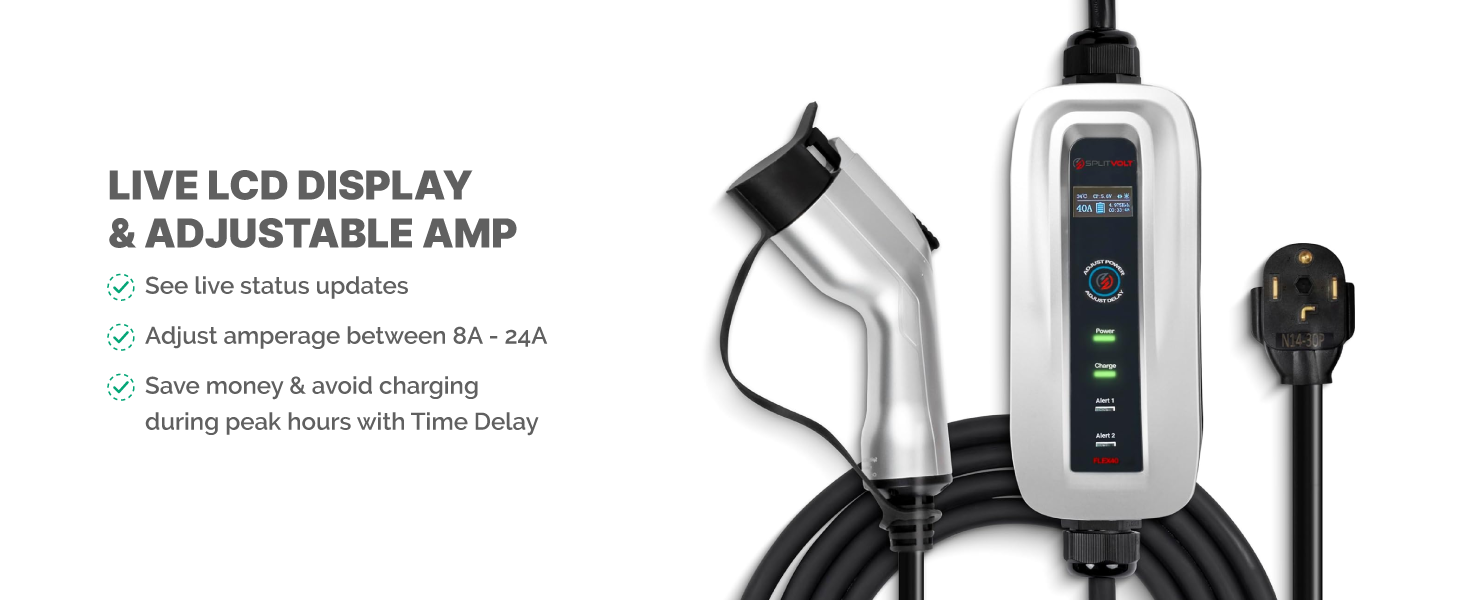
The Splitvolt Level 2 adjustable EV charger solves a specific, common problem: charging an EV from the 240V dryer outlet you already have. With a NEMA 14-30 plug, adjustable current up to 24A, and a 26ft cable, it turns a laundry-room circuit into a nightly charging point with zero electrical work. This review covers what the unit delivers, real-world speeds, who it fits, and how it compares with splitter hardware. For the unit itself, see the Splitvolt charger on Amazon.
Millions of garages and laundry rooms have a 240V NEMA 14-30 outlet built for a clothes dryer. That circuit can deliver 24A continuous to an EV, adding roughly 18 to 22 miles of range per hour, more than enough for the average commute overnight. The obstacle has always been that the dryer needs the same outlet. A charger designed for the 14-30 plug, used when the dryer is idle or paired with switching hardware, removes the need for a new circuit and its four-figure install bill. It is the pragmatic answer for renters and budget-minded homeowners alike.
The Splitvolt adjusts its draw, with a ceiling of 24A on a 30A dryer circuit and lower settings available for smaller or shared circuits. That flexibility is more useful than raw peak numbers: set 24A on a dedicated dryer circuit for maximum speed, drop to 16A or 12A on a questionable circuit or when other loads share the panel. The 80 percent continuous-load rule governs the ceiling, and a charger that lets you respect it is a safer, smarter tool than a fixed-rate unit that assumes perfect wiring everywhere.
| Setting | Power | Range / hour |
|---|---|---|
| 24A (14-30) | ~5.7 kW | ~18 to 22 mi |
| 16A | ~3.8 kW | ~11 to 13 mi |
| 12A | ~2.9 kW | ~8 to 10 mi |
At 24A a typical 60 kWh battery refills comfortably overnight. The 26ft cable reaches from a laundry outlet to a car parked in the driveway, which is exactly where dryer outlets usually sit relative to the parking spot.
The Splitvolt 14-30 charger is the reference pick for dedicated dryer-outlet charging. If the dryer and EV must share the outlet simultaneously, a smart power-sharing box is the better tool: our VEVOR NEMA splitter review covers that approach in detail. For maximum speed where a 14-50 exists, step up to a 40A portable like the MACH 3. The right tool depends purely on which outlet you can actually use.
Two tools serve the dryer-outlet world. The Splitvolt charger is the simple path when the outlet is free during charging hours. A smart splitter is the path when the dryer and EV must both stay connected and take turns automatically. The charger wins on simplicity and cost; the splitter wins on always-available charging. For most households that do laundry a few times a week, the dedicated charger plus a little coordination is the cheaper, cleaner answer.
Buy certified (UL or ETL) hardware with over-current, ground-fault, over-temperature, and surge protection. Keep the control box dry, off the floor in wet laundry rooms, and away from lint. Inspect the plug prongs for heat discoloration after long sessions; slight warmth is normal, melting is not. Our safety guide covers the full rules. A certified adjustable charger on a sound 30A circuit is a safe, forgiving setup.
If the 26ft cable runs through a doorway or window to reach the car, protect the run from pinching and weather. The control box itself should stay indoors or under cover. In freezing conditions, dry the connector before plugging and coil the cable loosely to avoid jacket stress. A charger that lives in a laundry room is naturally protected from the worst of winter, which is one of the quiet advantages of this setup over a garage wall unit.
Electricity is electricity: about $0.16/kWh, so a full 60 kWh fill runs roughly $10. The Splitvolt changes only how you reach that rate, not the rate itself. Compared with public charging at two to three times the per-kWh cost, a dryer-outlet charger pays for itself within months. Our cost guide runs the numbers for your local rates.
The Splitvolt Level 2 adjustable charger is one of the smartest ways to enter home charging without an electrician. Its NEMA 14-30 plug fits the dryer outlet millions of homes already have, the adjustable current respects real-world circuits, and the 26ft cable reaches the car. Pair it with a little laundry-time coordination, or use a smart splitter from our splitter guide for zero coordination. Either way, see the Splitvolt on Amazon and start charging tonight.
Living with a dryer-outlet charger is mostly about timing, and the rhythm is easier than it sounds. Most households do laundry a few times a week for an hour or two; the car charges the other twenty-two hours. A simple habit, plug the car in after the last load, covers the vast majority of weeks without a single conflict. On laundry days, the car loses an hour of charging and gains it back the next night. Families that write the rule on a sticky note near the outlet never think about it again. The economics are identical to any home charging; only the choreography is different, and it is a small chore.
Lorem Ipsum is simply dummy text of the printing and typesetting industry
Complete guide to EV charger load management: dynamic load balancing, power sharing, static allocation. Wallbox, Autel, Emporia. Avoid panel upgrades...
Best Level 1 EV chargers for 120V outlet charging. Lectron dual-voltage, Tesla Mobile Connector, Emporia. Tips, costs, safety, when to...
Complete guide to scheduling EV charging: TOU rates, smart charger apps, solar surplus charging, cost savings calculator. Emporia, Wallbox, ChargePoint...




