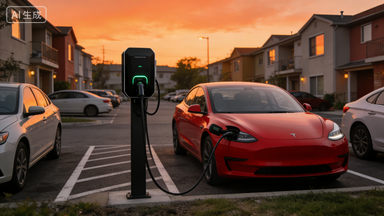
In the foreseeable future, most U.S. EV owners will still benefit from home charging. Public infrastructure is expanding rapidly, but overnight residential charging remains the most cost-effective and convenient solution. Even by 2035, home charging is expected to handle the majority of daily energy needs.
Free EV charging is commonly found at workplaces, municipal buildings, public libraries, hotels, shopping centers, universities, and some grocery stores. Availability is decreasing as utilization rises, but incentives are still used to attract customers or employees.
Yes. Many gas stations now host Level 2 or DC fast chargers, often operated by third-party networks. These locations leverage existing real estate, restrooms, and retail services, making them logical charging hubs.
Most public chargers require payment. Pricing may be based on energy (per kWh), time connected, or session fees. DC fast chargers are typically the most expensive, reflecting infrastructure and demand costs.
California’s public charging landscape is led by ChargePoint (Level 2 dominance), Tesla Supercharger (DC fast charging), and Electrify America. ChargePoint is the most prevalent by connector count, especially in urban and workplace settings.
EVs require fewer refueling stops because most charging occurs at home or work. Additionally, a single charging location can serve multiple vehicles for longer durations, reducing the need for the same station density as gasoline pumps.
Chargers will become widespread, but not identical in form. Instead of standalone stations, chargers will be embedded into parking lots, workplaces, apartments, retail centers, and curbside infrastructure.
Technically yes, but not universally practical. Grid capacity, transformer upgrades, and land constraints limit full deployment. High-traffic and highway stations are the most likely candidates for large-scale DC fast charging.
Most public sites install 2–6 Level 2 chargers, while highway fast-charging hubs typically deploy 4–12 DC fast chargers. Density is increasing as EV adoption grows and utilization data improves planning accuracy.
Key takeaway: Public EV charging is expanding rapidly, but it is designed to complement—not replace—home charging. The future network will be more distributed, data-driven, and integrated into everyday destinations rather than centralized fueling stops.
Lorem Ipsum is simply dummy text of the printing and typesetting industry
Complete guide to EV charger load management: dynamic load balancing, power sharing, static allocation. Wallbox, Autel, Emporia. Avoid panel upgrades...
Best Level 1 EV chargers for 120V outlet charging. Lectron dual-voltage, Tesla Mobile Connector, Emporia. Tips, costs, safety, when to...
Complete guide to scheduling EV charging: TOU rates, smart charger apps, solar surplus charging, cost savings calculator. Emporia, Wallbox, ChargePoint...




