
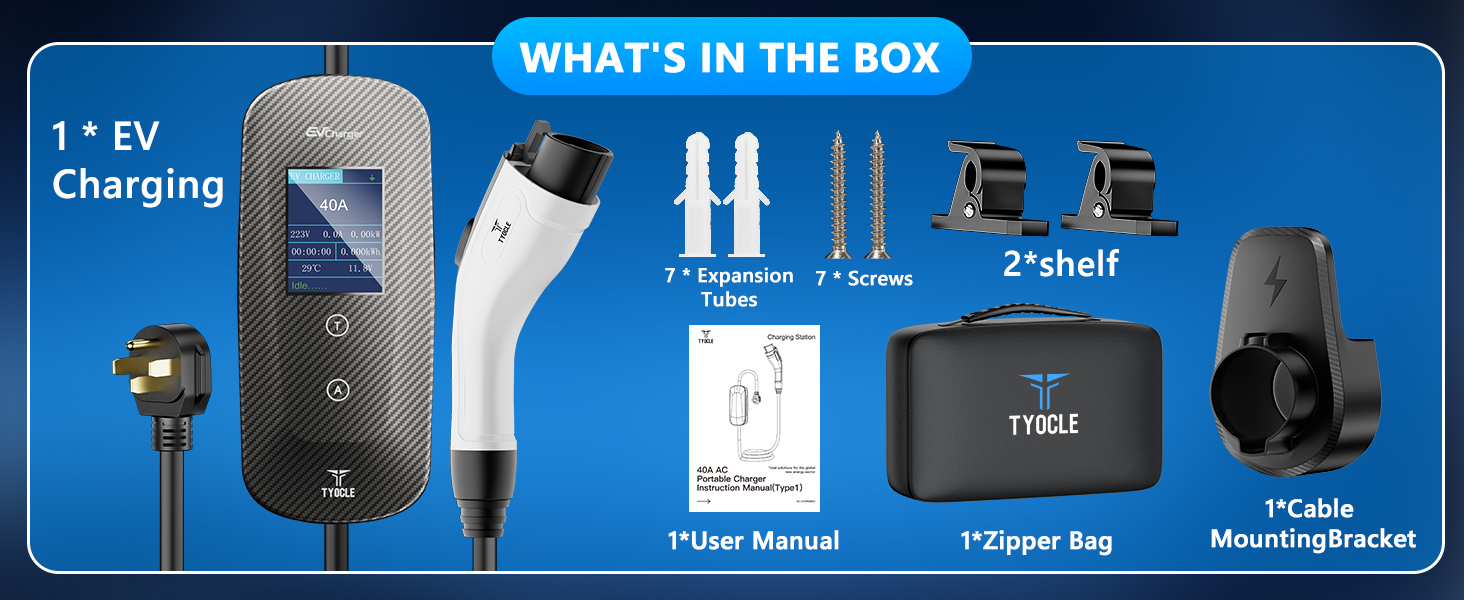
A portable 40A Level 2 EV charger with a 23ft cable packs near-wall-charger speed into a bag. On a NEMA 14-50 outlet it delivers up to 9.6 kW, about 25 to 30 miles of range per hour, and the 23ft cable reaches awkward parking without extension cords. This class of mobile EVSE is the road-trip workhorse and the renter’s best friend. This review covers real speeds, who it fits, outlet needs, travel use, and our verified picks. For the reference unit, see this 40A portable on Amazon.
The defining traits are 40A output, a 240V NEMA 14-50P plug, and a 23ft cable. That combination is the RV-park and pedestal standard: nearly every campground pedestal and many garages already have the 14-50 outlet. A 40A portable turns any such outlet into a fast home-like charging station. For a unit purpose-built for travel, the 40A 23ft portable on Amazon is the reference; the MACH 3 40A adds native NACS for Tesla drivers.
| Plug | Power | Range / hour |
|---|---|---|
| 5-15 (120V) | 1.9 kW | ~5 to 7 mi |
| 14-50 (240V, 40A) | 9.6 kW | ~25 to 30 mi |
On a 14-50 pedestal the difference is dramatic: an overnight stop adds 200-plus miles instead of 50. The 23ft cable matters at RV parks and shared lots where the outlet is rarely beside the charge port.
In the 40A portable class we recommend the 40A 23ft portable for typical travel, the MACH 3 40A when you want native Tesla NACS plus J1772, and the 25ft 40A portable when maximum cable reach matters. All are certified mobile EVSE built for repeated coiling and road use. Our best portable chargers roundup compares the wider field.
The 40A portable shines on the road. At a campground pedestal it charges at home-like speed overnight; at a friend’s garage it turns an existing 14-50 into a fast session. Coil the 23ft cable in loose loops, keep the control box dry and off hot pavement, and store the unit indoors between trips. The long cable is a safety feature: it prevents awkward parking angles that strain the connector. For the odd 120V night, keep a simple adapter in the bag and accept the slower speed.
| Option | Speed | Portable? | Install |
|---|---|---|---|
| 40A portable | ~25 to 30 mi/hr | Yes | Outlet only |
| 48A wall charger | ~35 to 40 mi/hr | No | Hardwired |
A wall charger is marginally faster and tidier for one fixed home. The portable delivers nearly the same speed and moves with you. Many owners keep both: the wall unit daily and the portable as travel backup.
Insist on UL or ETL certification with over-current, over-temperature, ground-fault, and surge protection. Never extend the unit with a household cord, and never force a wrong outlet with adapters. Keep the control box off the ground in rain and inspect the jacket for cuts monthly. Our safety guide covers the rules. A certified 40A portable used correctly is as safe as any wall unit.
Portables face more weather than wall units. In freezing conditions, dry the connector before plugging and avoid a frozen cable that kinks the conductors. In heat, keep the control box out of direct sun; thermal throttling is normal and protective. A weather-rated unit survives rain and snow, while a good habit of indoor storage extends its life. The 23ft cable should be coiled loosely to avoid jacket stress in cold.
Electricity is the same wherever you plug in: about $0.16/kWh at home rates, so a 75 kWh fill is roughly $12. The portable makes that rate available at RV parks, cabins, and friends’ houses where you would otherwise pay public fast-charging prices. Our cost guide runs the comparison. Over a travel season, the savings versus DC fast charging can repay the unit itself.
A portable 40A Level 2 charger with a 23ft cable is the most flexible fast charger you can own: near-wall-charger speed anywhere a 14-50 exists, with a cable long enough for real parking situations. Our reference pick is the 40A 23ft portable, with the MACH 3 for Tesla households. Match it to a proper 50A circuit, keep it certified, and it becomes the charging backbone at home and the safety net on the road.
A 40A portable earns its keep when it travels with the right accessories. Pack a certified NEMA 14-50 to 5-15 adapter for the odd 120V night, a small tarp or mat to keep the control box off wet ground, a microfiber cloth for the connector, and a printed list of the outlet types at your regular stops. A labeled tote keeps everything together so a passenger can find it in the dark. None of this is heavy or expensive, but it turns a single charger into a complete road kit that handles almost any outlet you meet between home and destination.
Renters are the hidden winners in the portable class. If your building has a shared 14-50 dryer or workshop outlet you are allowed to use, a portable charger turns that access into nightly charging with zero installation and zero landlord negotiation. Move-out day, the charger goes with you to the next place. The trade-off is coordination: on shared outlets you charge when the circuit is free and respect your neighbors. For tenants who cannot install anything, this is the realistic path to cheap home charging today.
A portable lives a harder life than a wall unit: it gets coiled, dropped, rained on, and frozen. The habits that keep a 40A portable healthy are simple: coil the cable in loose loops, never yank the plug out by the cord, dry the control box before storage, and inspect the jacket monthly for cuts or stiff spots. A unit that is cared for this way lasts years of road-trip service and remains useful as a backup even after you install a wall charger. Abuse it and even certified gear fails early.
Lorem Ipsum is simply dummy text of the printing and typesetting industry
Complete guide to EV charger load management: dynamic load balancing, power sharing, static allocation. Wallbox, Autel, Emporia. Avoid panel upgrades...
Best Level 1 EV chargers for 120V outlet charging. Lectron dual-voltage, Tesla Mobile Connector, Emporia. Tips, costs, safety, when to...
Complete guide to scheduling EV charging: TOU rates, smart charger apps, solar surplus charging, cost savings calculator. Emporia, Wallbox, ChargePoint...




