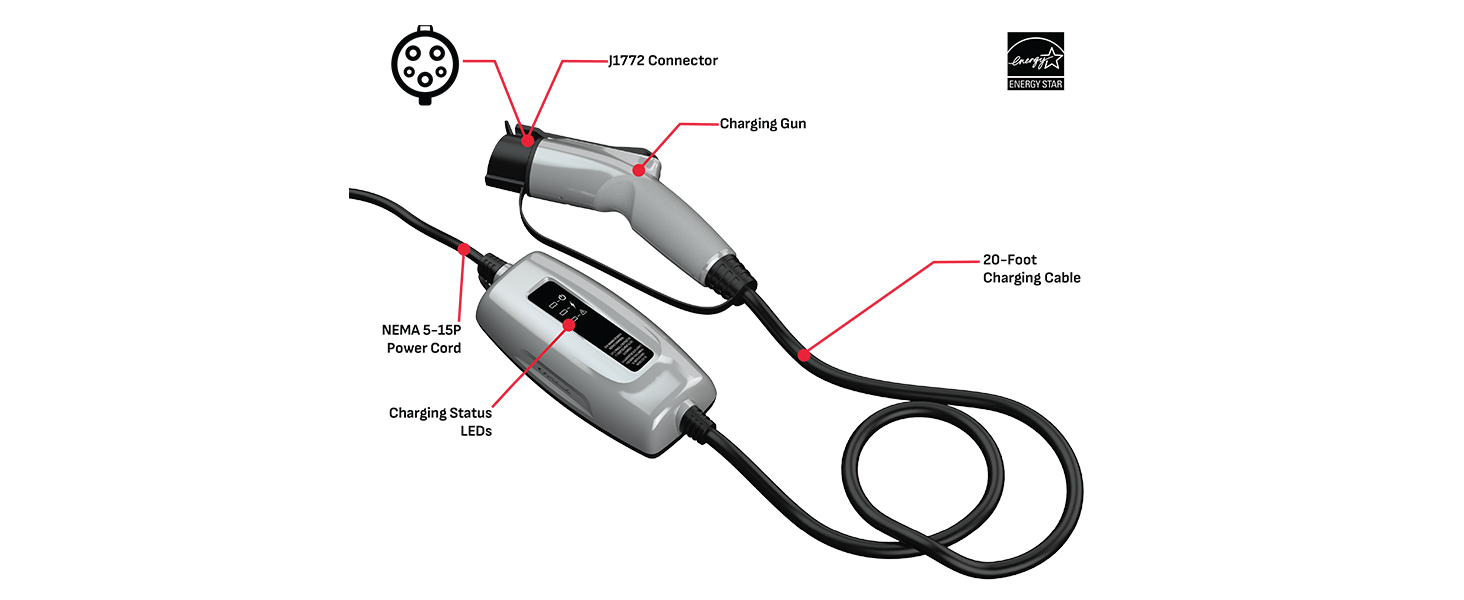
The Schumacher Level 1 portable EV charger is a 12A, 120V, NEMA 5-15P charging cord from a brand with decades in automotive electrical gear. It plugs into any standard household outlet and adds a modest but dependable number of miles overnight, with an indoor/outdoor rating that suits emergency and backup duty. This review covers what a 12A Level 1 unit delivers, who it genuinely suits, its limits, and the upgrade path to Level 2. For the unit itself, see the Schumacher Level 1 charger on Amazon.
| Plug | Power | Range / hour |
|---|---|---|
| 5-15 (120V, 12A) | ~1.44 kW | ~4 to 5 mi |
| 5-15 (120V, 8A) | ~0.96 kW | ~3 mi |
At 12A the charger adds roughly 4 to 5 miles per hour, so a ten-hour overnight session gives 40 to 50 miles. That is honest, useful charging for very low-mileage drivers, plug-in hybrids with small packs, and anyone who needs a reliable emergency cord. The Schumacher name matters here: this is the cord you keep in the trunk for a decade, not the one you experiment with.
The honest test is arithmetic: multiply your overnight hours by 4 miles and compare with your daily driving. If the number beats your routine, Level 1 is complete. If not, it is a supplement, and the upgrade path below is short.
Level 1 punishes high mileage. A 40-mile commuter on 12A wakes up short more often than not, and long trips are impossible without public charging. Cold weather compounds the problem, dropping the effective rate toward 2 to 3 miles per hour on freezing nights. None of this is the charger’s fault; it is physics at 120V. Knowing the limit up front prevents the frustration of discovering it on a morning when you needed a full battery.
The natural step up is a 16A dual-voltage portable like the 16A 17ft portable, which lifts the same wall outlet to 6 to 7 miles per hour and flips to 240V for 13 to 15 miles per hour where a NEMA 6-20 exists. One purchase roughly doubles home speed and adds Level 2 capability. Our Level 1 vs Level 2 guide explains the difference in detail. Keep the Schumacher as the backup even after upgrading; it is the cord that always works.
Level 1 chargers are commodities except for one thing: build quality you can trust in an emergency. Schumacher has spent decades in battery chargers and jump starters, and that heritage shows in a cord designed for indoor and outdoor use with clear, simple construction. For a device that may sit in a trunk for a year and then need to work flawlessly in the rain, brand confidence is the actual feature. The Schumacher Level 1 charger earns its place on that basis.
The indoor/outdoor rating is what separates this unit from cheap cords. It can sit by an open garage door or under an eave in drizzle and keep working, which is exactly the duty an emergency charger sees. Still, keep the control box out of standing water, dry the connector before use, and inspect the cord jacket seasonally. A little care preserves the reliability that made you buy a name brand in the first place.
Level 1 costs the same per kilowatt as Level 2: about $0.16/kWh, so a 60 kWh fill is roughly $10 whether it takes ten hours or four. You pay in time, not in price. That is why Level 1 suits low-mileage drivers perfectly and why the upgrade to Level 2 is about convenience rather than fuel savings. Our cost guide runs the full home-versus-public comparison.
Picture a household with one PHEV and a small commuter EV. The Schumacher lives on a garage wall outlet and keeps the PHEV full on pennies a night; the EV charges on a Level 2 unit elsewhere. When a relative visits with a low battery, the Schumacher saves the weekend without any rearranging. This is the quiet value of a trusted Level 1 cord: it is never the star, but it is always there when the plan falls apart.
Cold slows Level 1 more than any other charging mode. A frozen battery accepts current reluctantly, so a 12A overnight that normally adds 45 miles may add 30 in a deep freeze. Keep the connector dry, never force a frozen plug, and give the car time to warm before expecting full speed. For drivers in harsh winters who commute daily, that seasonal hit is the strongest argument for the 16A upgrade.
The Schumacher Level 1 portable charger is the right tool for low-mileage drivers, plug-in hybrids, and emergency backup duty, delivered with a brand pedigree that matters in the moment you need it. It will not replace Level 2 for daily high-mileage use, and it is not trying to. Keep one in the garage and one in the trunk, and when your driving grows, move to a 16A dual-voltage portable while keeping the Schumacher as the safety net. See it on Amazon and start with the tool that always works.
An emergency charger only helps if it works the day you reach for it, so treat the Schumacher like any other emergency tool. Keep it coiled loosely in a labeled bag in the trunk or on a garage shelf, away from sharp tools that could cut the jacket. Once a season, uncoil it, inspect the cord and plug, and run a short test charge on a car or even a device that draws safely, so you know the unit still functions after months of storage. Check that the outlet you plan to use in an emergency is actually the one you tested. This half-hour of attention per year is what separates a useful safety net from dead weight in the trunk.
Lorem Ipsum is simply dummy text of the printing and typesetting industry
Complete guide to EV charger load management: dynamic load balancing, power sharing, static allocation. Wallbox, Autel, Emporia. Avoid panel upgrades...
Best Level 1 EV chargers for 120V outlet charging. Lectron dual-voltage, Tesla Mobile Connector, Emporia. Tips, costs, safety, when to...
Complete guide to scheduling EV charging: TOU rates, smart charger apps, solar surplus charging, cost savings calculator. Emporia, Wallbox, ChargePoint...




