240V / 220V EV Chargers and NEMA Outlets Explained

A professional guide to NEMA 14-50, 6-50, 14-30, and 240V EV chargers

In North America and many other regions, EV charger performance is closely tied to outlet type and supply voltage. Search terms such as NEMA 14-50 EV charger, NEMA 6-50 EV charger, NEMA 14-30 EV charger, 240V EV charger, and 220V EV charger are frequently used, but they are often misunderstood or conflated.

This article provides a technically accurate, practical explanation of these outlet standards and how they relate to Level 2 EV charging.


1. What Is a 240V / 220V EV Charger?

A 240V EV charger (sometimes called a 220V EV charger) refers to a Level 2 AC charger powered by a split-phase or single-phase high-voltage residential supply.

Important clarification (technical accuracy)

  • In North America, residential Level 2 charging is typically 240V
  • In casual usage, 220V EV charger is often used interchangeably, even though the nominal voltage is 240V
  • Both terms usually describe the same category of EV charger

A 240V charger delivers significantly more power than a standard 120V outlet and is the foundation of practical home EV charging.


2. NEMA Outlets and EV Charging

NEMA (National Electrical Manufacturers Association) outlet types define:

  • Voltage
  • Maximum current
  • Pin configuration
  • Grounding method

For EV charging, three NEMA outlets dominate residential and light-commercial installations.


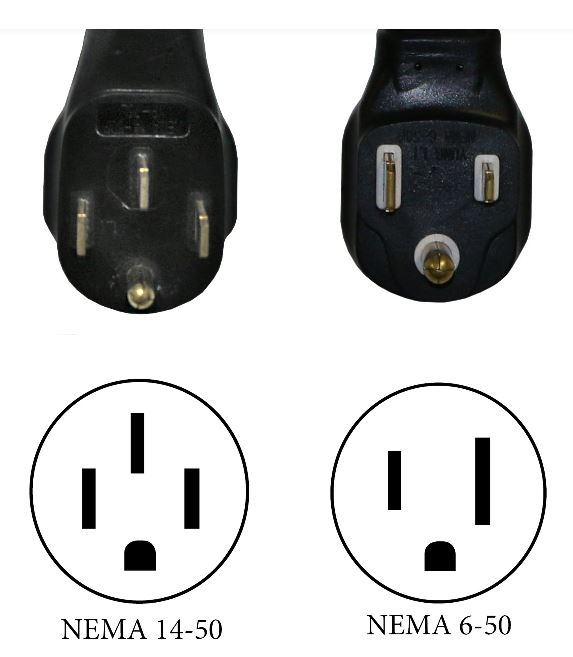
3. NEMA 14-50 EV Charger

What is a NEMA 14-50 EV charger?

A NEMA 14-50 EV charger is a Level 2 charger designed to plug into or be hardwired to a NEMA 14-50 outlet, one of the most common high-power outlets in North America.

Electrical characteristics

  • Voltage: 240V
  • Breaker rating: 50A
  • Continuous charging current: 40A
  • Typical power: ~9.6 kW

Why NEMA 14-50 is so popular

  • Widely used for RV parks and electric ranges
  • Strong grounding and neutral support
  • Compatible with many portable and wall-mounted EV chargers

For many homeowners, a NEMA 14-50 EV charger represents the best balance of charging speed, cost, and electrical availability.


4. NEMA 6-50 EV Charger

What is a NEMA 6-50 EV charger?

A NEMA 6-50 EV charger connects to a 240V, 50A outlet without a neutral wire. This outlet type is commonly found in welding equipment installations.

Electrical characteristics

  • Voltage: 240V
  • Breaker rating: 50A
  • Continuous charging current: 40A
  • Typical power: ~9.6 kW

When is NEMA 6-50 used for EV charging?

  • Garages with existing welder outlets
  • Installations where a neutral conductor is unnecessary
  • Dedicated EV charging circuits

Functionally, a NEMA 6-50 EV charger performs similarly to a NEMA 14-50 charger, but wiring requirements differ.


5. NEMA 14-30 EV Charger

What is a NEMA 14-30 EV charger?

A NEMA 14-30 EV charger is designed for a 240V, 30A outlet, commonly used for electric dryers.

Electrical characteristics

  • Voltage: 240V
  • Breaker rating: 30A
  • Continuous charging current: 24A
  • Typical power: ~5.7 kW

Best use cases

  • Apartments and condos
  • Homes with limited panel capacity
  • Situations where a dryer outlet already exists

While slower than 14-50 or 6-50 options, a NEMA 14-30 EV charger still provides meaningful overnight charging for most daily driving needs.


6. Comparing NEMA 14-50, 6-50, and 14-30

Outlet TypeBreakerContinuous AmpsApprox. PowerTypical Use
NEMA 14-50 EV charger50A40A~9.6 kWHome, RV-style installs
NEMA 6-50 EV charger50A40A~9.6 kWGarage, welder circuits
NEMA 14-30 EV charger30A24A~5.7 kWDryer outlet charging

7. Plug-In vs Hardwired 240V EV Chargers

Plug-in EV chargers

  • Use NEMA 14-50, 6-50, or 14-30 plugs
  • Easier to replace or relocate
  • Ideal for renters or temporary installations

Hardwired 240V chargers

  • Directly connected to the electrical panel
  • Support higher continuous current
  • Often required for 48A and above installations

Both approaches are considered 240V EV chargers, and the choice depends on electrical capacity and local code requirements.


8. Safety and Electrical Code Considerations

All 240V / 220V EV chargers must comply with:

  • Continuous load rules (typically 80% of breaker rating)
  • Proper grounding
  • Appropriate cable and breaker sizing
  • Local electrical codes and inspection requirements

Using the correct NEMA outlet type is essential for safe, reliable, and insurable EV charging.


Final Practical Guidance

  • NEMA 14-50 EV chargers are the most versatile and future-proof for residential charging
  • NEMA 6-50 EV chargers are ideal when a welder outlet already exists
  • NEMA 14-30 EV chargers provide a cost-effective solution for limited electrical capacity
  • 240V EV chargers and 220V EV chargers generally refer to the same Level 2 charging category

Choosing the correct outlet and voltage configuration ensures optimal charging speed, electrical safety, and long-term compatibility with evolving electric vehicle needs.

Leave a Reply

Your email address will not be published. Required fields are marked *

Related Blogs

Lorem Ipsum is simply dummy text of the printing and typesetting industry

EV Charging Decisions and Infrastructure Reality: MG Charge (India), State Deplo …

EV Charging Decisions and Infrastructure Reality: MG Charge (India), State Deployment Barriers, Texas Connector Policy, Robotics, Reliability, Roaming in Europe,...

EV Charger Installation & Charging Strategy Guide (West Midlands, Birmingham …

EV Charger Installation & Charging Strategy Guide (West Midlands, Birmingham & Beyond): Costs, Timelines, Grants, Cybersecurity, Solar, and Buying Advice...

EV Charging in Practice: Public Charging Costs, Best Home Chargers (London), Ins …

EV Charging in Practice: Public Charging Costs, Best Home Chargers (London), Installation Reality (Kansas City), Malaysia Buying Options, and Solar...
