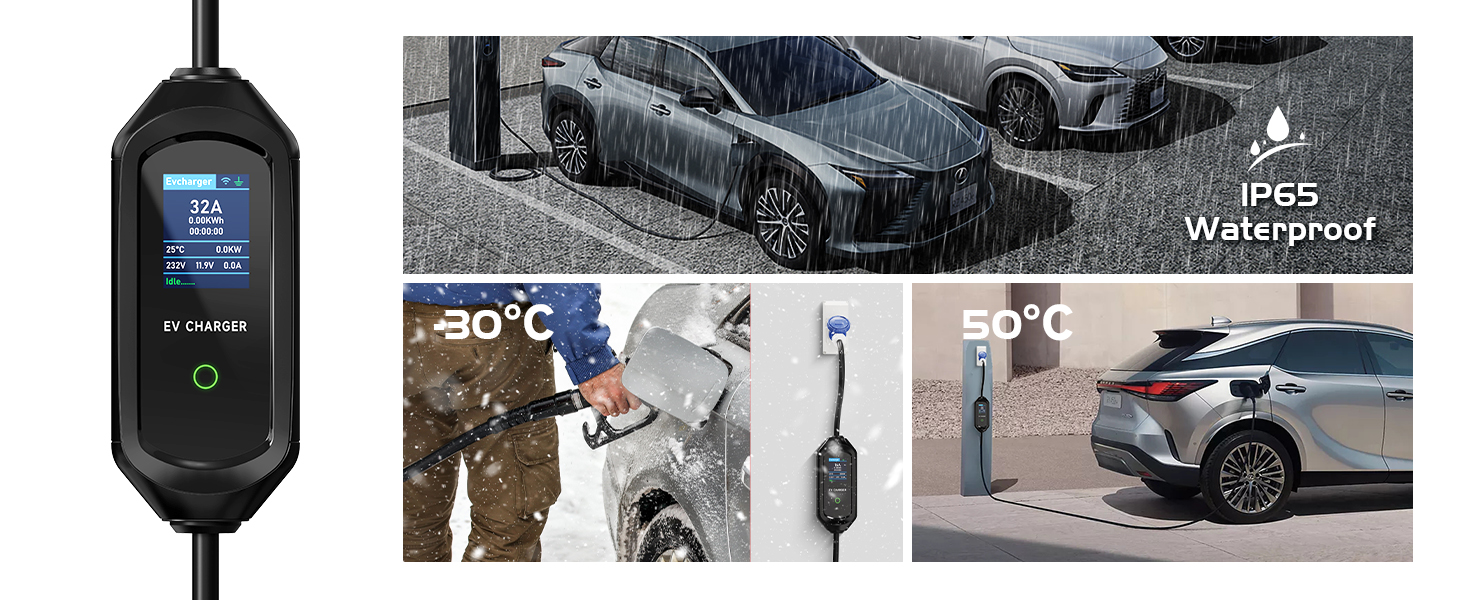
A 7.2kW Type 2 charging cable with adjustable 6A to 32A current is a capable, feature-rich portable EVSE, but it solves a problem most American EV owners do not have. Type 2, also called Mennekes or IEC 62196-2, is the AC charging standard used across Europe and many other markets. Vehicles sold in the United States use J1772 for AC charging, or NACS on newer Teslas and a growing list of 2025-plus models. Before considering this unit, read the compatibility section below: for the vast majority of US readers, a J1772 or NACS charger is the correct purchase. If you specifically need Type 2 hardware, see the 7.2kW Type 2 cable on Amazon.
There are legitimate buyers in the US: owners of imported European-market vehicles, people shipping a charger overseas, industrial or test-fleet setups with CEE sockets already installed, and travelers who want one cable for a European rental car. Outside those cases, the right move is a US-standard unit. Our connector and adapter guide walks through J1772, NACS and CCS in detail.
If none of the first three describes you, skip to our verified US-standard picks below. That is not a criticism of the product; it is a standards mismatch.
At 230V and 32A the unit delivers about 7.2 kW, which in a compatible vehicle adds roughly 25 to 30 miles of range per hour depending on efficiency. On a US 240V supply the arithmetic is similar in magnitude, but the plug, the grounding arrangement and the vehicle inlet still have to match. The 80 percent continuous-load rule applies everywhere: a 32A continuous draw needs a 40A or larger branch circuit. Never assume a nominal outlet rating supports the full number on the box.
| Setting | Power at 230V | Typical use |
|---|---|---|
| 32A | ~7.2 kW | Dedicated high-power circuit |
| 24A | ~5.5 kW | Shared or 30A circuit |
| 16A | ~3.7 kW | Older wiring, overnight charging |
| 6A to 13A | ~1.4 to 3.0 kW | Weak or uncertain supply |
The wide 6A to 32A range is the best part of the design. One charger adapts to the circuit instead of demanding the circuit adapt to it, which is exactly what you want on the road or in older buildings. Owners who travel between properties with very different wiring get real value from this flexibility.
This class of unit typically pairs a 2.8-inch LED screen with a smartphone app over Wi-Fi or Bluetooth. The screen shows current, voltage, temperature, delivered energy and session time; the app adds remote current adjustment and a delayed start of up to 15 hours. Delayed start is more than a gadget: shifting a session into off-peak hours is the simplest way to cut charging cost without changing hardware. Our charging cost guide shows how much time-of-use rates can move the bill. A physical screen also helps when the app will not connect, which is a real advantage in a garage with weak Wi-Fi.
Listings in this category commonly claim leakage, short-circuit, over-temperature, grounding, over-current, under-voltage, over-voltage and water-resistance protection, often alongside UL or FCC markings. Treat those as claims to verify rather than assurances: look for a recognized certification mark on the actual unit and label, not just in the listing text. Grounding protection deserves special attention when an adapter or a non-standard socket is involved. Our safety guide covers what to check before first use, and any charger used across different countries should be reviewed against local electrical code by a qualified electrician.
For a US vehicle, these are the products that actually fit. The Emporia Level 2 charger and ChargePoint Home Flex are the smart wall-charger picks. The MACH 3 40A portable covers mixed Tesla and J1772 households, while the 16A dual-voltage portable is the budget travel option. Tesla-only owners should consider the Tesla Wall Connector. Compare the full field in our best portable chargers roundup.
| Standard | Region | AC / DC | Typical use |
|---|---|---|---|
| Type 2 (Mennekes) | Europe and others | AC | Home and public AC posts |
| J1772 | North America | AC | Home and public Level 2 |
| NACS (SAE J3400) | North America | AC and DC | Tesla and newer models |
| CCS1 / CCS2 | NA / EU | DC | Highway fast charging |
Note that NACS handles both AC and DC in one compact connector, which is why the North American market is converging on it. An adapter can bridge some AC combinations, but no passive adapter turns a Type 2 EVSE into a safe, code-compliant everyday J1772 solution. Standards are not interchangeable accessories.
Even if you own a Type 2 vehicle, feeding this unit in a US home usually means an electrician: CEE industrial sockets are not standard residential wiring here, and the supply characteristics differ. A properly permitted 240V branch circuit with the right receptacle, breaker and grounding is a job for a licensed electrician, not a plug adapter. Our installation cost guide explains what a dedicated circuit involves and what it typically costs. For most US households, installing a circuit for a US-standard charger is both cheaper and more useful.
The 7.2kW Type 2 adjustable charging cable is a well-featured portable EVSE with genuinely useful amperage range, a clear display and app-based scheduling. It is also the wrong product for almost every US EV owner. If you have a Type 2 vehicle or European infrastructure, see the 7.2kW Type 2 cable on Amazon and have the circuit checked by an electrician. If you drive a US-market EV, choose from our verified portable chargers instead and read our connector guide first. Getting the standard right is worth more than any feature on the box.
A charger is not like a phone cable where a cheap adapter fixes everything. EVSE equipment negotiates with the car, monitors ground integrity and carries a sustained high load for hours. Every adapter in that path adds contacts that can heat up and a potential point of failure in the safety chain. Worse, a mismatched purchase often looks fine at checkout and only reveals itself on delivery day, after the return window has narrowed and an electrician may already have been booked. Reading the connector standard before the feature list is the single highest-value five minutes in the whole buying process. Our Level 1 versus Level 2 guide is a good next step if you are also deciding how much power you actually need at home.
Lorem Ipsum is simply dummy text of the printing and typesetting industry
Complete guide to EV charger load management: dynamic load balancing, power sharing, static allocation. Wallbox, Autel, Emporia. Avoid panel upgrades...
Best Level 1 EV chargers for 120V outlet charging. Lectron dual-voltage, Tesla Mobile Connector, Emporia. Tips, costs, safety, when to...
Complete guide to scheduling EV charging: TOU rates, smart charger apps, solar surplus charging, cost savings calculator. Emporia, Wallbox, ChargePoint...




