Best Practices and Buyer Guidance: Used EV Chargers, Road-Trip Workarounds, Residential Regulations, Compatibility, Power Limits, ESS, UK Property Benefits, U.S. Policy Context, and Safe Disconnecting
1) Best place to sell a used EV charger
The “best” channel depends on whether you are selling (a) a portable EVSE (granny cable / travel charger) or (b) a wallbox / hardwired unit, and whether you have proof of purchase + installation paperwork.
Highest-probability channels (fast sale, broad demand)
- Local marketplaces (fastest pickup, avoids shipping): Facebook Marketplace, Craigslist (US), OfferUp (US), Gumtree (UK), local EV owner groups/forums.
- General e-commerce resale (largest audience, better pricing for premium brands): eBay.
Best channel for higher ASP (more effort, better yield)
- Specialist EV communities (buyers are more informed; less price compression): EV forums, Tesla/Leaf/Ioniq/Kia EV groups, UK EV Facebook communities, local “EV owners” clubs.
Commercial buyers (best if you have multiple units)
- Local electricians/installer partners, property managers, small fleets—especially if you can bundle RCD/RCBO, load-management hardware, pedestals, spare cables.
Critical listing checklist (to protect you and the buyer)
- Exact model, amperage, connector type (Type 1/Type 2/J1772/NACS), cable length.
- Photos of labels/serial number (partially masked), plug and vehicle connector.
- Whether it is plug-in or hardwired (hardwired resale often requires a qualified electrician to reinstall).
- Any certification marks relevant to your country (UKCA/CE; UL/ETL in the US).
- Condition + reason for sale + known faults.
- Include installation certificate if it was a wallbox (materially increases trust and resale value).
2) A creative solution a Tesla owner used in a town with no EV charger
A widely reported case involved a Tesla owner on a rural road trip who trickle-charged from a standard outlet at an abandoned gas station, effectively using any available safe mains power source when no dedicated charging infrastructure existed. Business Insider
Practical takeaway for customers: in emergencies, low-power AC charging (with permission and safe wiring) can be a viable “bridge” to the next proper charger—though it is slow and should be treated as a contingency, not a plan.
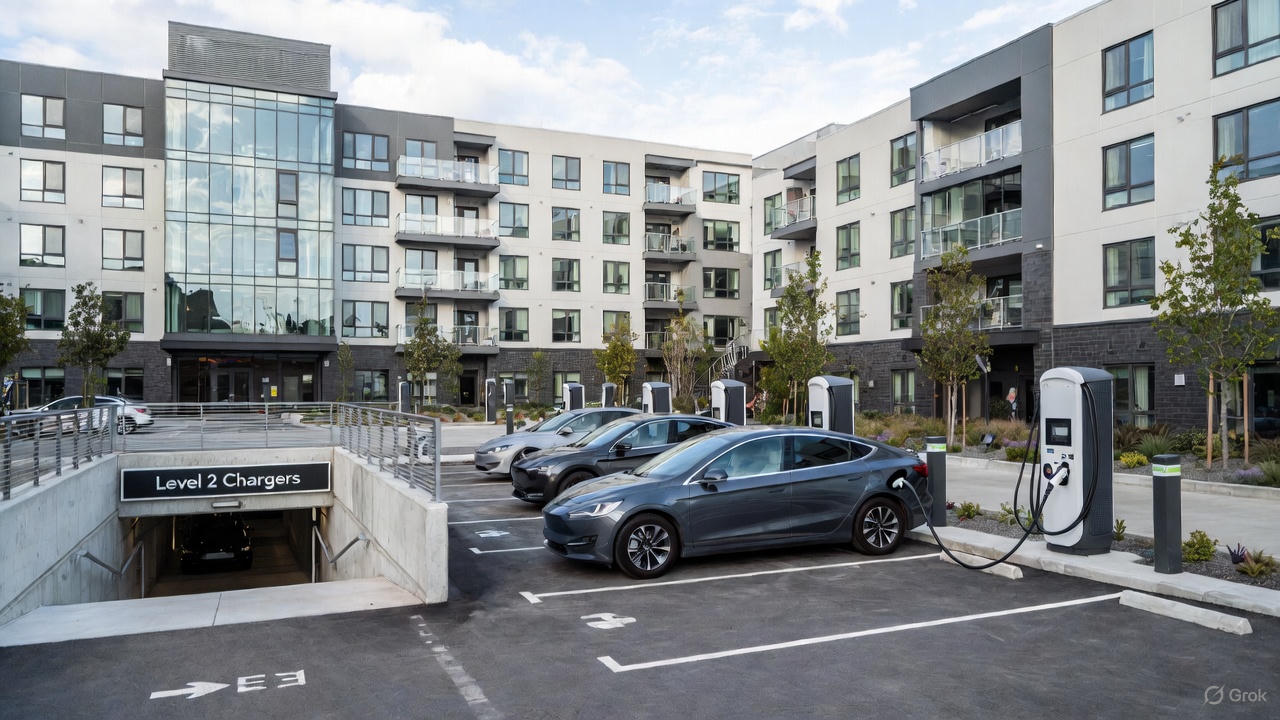
3) Guidelines/regulations for installing EV chargers in residential complexes or apartment buildings (UK)
In the UK, multi-unit residential charging projects usually need to satisfy building regulations, electrical safety rules, and property/landlord permissions. Key anchors:
- Building Regulations (England): Part S provides technical guidance for EV chargepoint requirements in certain building contexts. uk
- For individual home charger installs, installing a new circuit is typically treated as notifiable work unless completed by a competent person who can self-certify. uk
- For flats/apartments, the practical pathway often hinges on freeholder/managing agent approval and a design that accounts for load management, metering, and allocation of costs. WarmZilla®+1
Best-practice requirements in apartment settings (what professionals implement)
- Load assessment for the whole building; apply dynamic load management.
- Clear billing/metering approach: per-bay submetering, RFID user billing, or back-office allocation.
- Fire and cable routing considerations (containment, penetrations, signage), plus maintenance access.
- Governance: resident policy, enforcement, and upgrade roadmap (future bays).
4) Are home EV chargers compatible with all EVs in the UK?
In most cases yes for AC home charging, but “universal” is not absolute.
- The UK market largely standardizes on Type 2 for AC charging, but vehicle-side limits vary. RAC+1
- Compatibility depends on:
- Connector (almost always Type 2 for modern UK EVs)
- Vehicle onboard charger limit (e.g., 7 kW vs 11 kW; some cannot use higher AC rates even if the wallbox is 22 kW)
- Smart features (app integrations; tariff integrations; OCPP capability)
If your customer has an older import or a vehicle with unusual inlet standards, confirm connector type and onboard charger rating before purchase.
5) Maximum power output of an EV charger
This must be framed by use case:
Passenger vehicles (typical public DC fast charging today)
- Many public DC fast chargers are commonly deployed up to 350 kW, though real delivered power depends on vehicle acceptance and battery conditions. Power-Sonic
Heavy-duty / next-generation systems
- Megawatt-class charging (for trucks) targets up to 3.75 MW (3,750 kW) in current MCS discussions and industry materials. Keysight+2cdn.vector.com+2
Key buyer point: “Maximum charger output” is not the same as “what the car will take.” The vehicle’s battery voltage architecture and thermal limits govern acceptance.
6) Why there aren’t more public EV chargers
The constraints are typically grid + economics + execution:
- Grid capacity and interconnection lead times (transformer upgrades; utility studies).
- Demand charges / operating cost volatility for high-power sites.
- Permitting, landlord negotiations, and site design (ADA, parking re-striping, civil works).
- Utilization risk: a fast charger is capex-heavy; if it sits idle, payback collapses.
- Reliability and maintenance: parts, technicians, vandalism risk, and software uptime.
This is why many markets prioritize corridors and high-traffic nodes first, then densify.
7) Before buying an EV charger with an ESS (Energy Storage System)
An EV charger paired with an ESS (battery-buffered charging) can be excellent—but only when the customer understands the tradeoffs.
What ESS can do well
- Reduce peak grid draw and buffer high-power charging when utility upgrades are slow. driveelectric.gov+1
- Improve site economics by smoothing peaks (site-specific; depends on tariff design). driveelectric.gov
What to verify before purchase
- Power vs energy sizing: how many high-power sessions you want to support before the battery depletes.
- Cycle life and warranty (throughput-based warranties matter more than years).
- Safety and permitting: fire safety, placement, ventilation/thermal management.
- Controls integration: how the ESS interacts with charger power modules and back office.
- Total cost of ownership: battery replacement horizon, maintenance contracts, software fees.
8) Benefits of installing an EV charger on your property in the UK
For homeowners/tenants (where eligible)
- Convenience, controlled charging schedules, and potential savings via off-peak tariffs.
- In certain scenarios, government support exists (eligibility-specific).
For landlords and multi-occupancy properties
- Improved property attractiveness for EV drivers and future-proofing parking assets.
- Grant structures exist for landlords and infrastructure work (eligibility and caps apply).
9) Why Biden vetoed a bill about EV charger “Buy America” (and what it actually meant)
The veto was not simply “forcing all EV chargers to be made in America.” The measure aimed to reverse a federal waiver related to Buy America requirements for government-funded EV charging stations; President Biden vetoed that legislation. Reuters+1
Client-relevant implication: U.S. public funding rules can affect sourcing, compliance paperwork, and project timelines, but do not automatically convert into a blanket ban on non-U.S. components across the entire private market.
10) Consequences of not disconnecting your EV charger when charging is finished
This depends on what you mean by “disconnecting”:
A) Leaving the EVSE plugged into the wall (no vehicle attached)
- Usually a small phantom load, but across many devices it can add up.
- Continuous plug-in can increase wear and, in some scenarios, raise safety risk if the device/cable is damaged. Better Homes & Gardens+1
B) Leaving the connector plugged into the car after the session
- Usually not harmful in itself; modern EVs manage charging safely.
- Practical risks: someone could unplug you, trip hazard, cable exposure to weather/impact, and potential lock/unlock behavior depending on vehicle settings.
- For shared/public settings, it can create bay blocking issues and fees (market-specific).
Best practice
- If at home: leaving it connected overnight is normal; disconnect when done if you want to minimize wear and reduce clutter risk.
- If on public charging: disconnect promptly to avoid idle fees and improve station availability.