
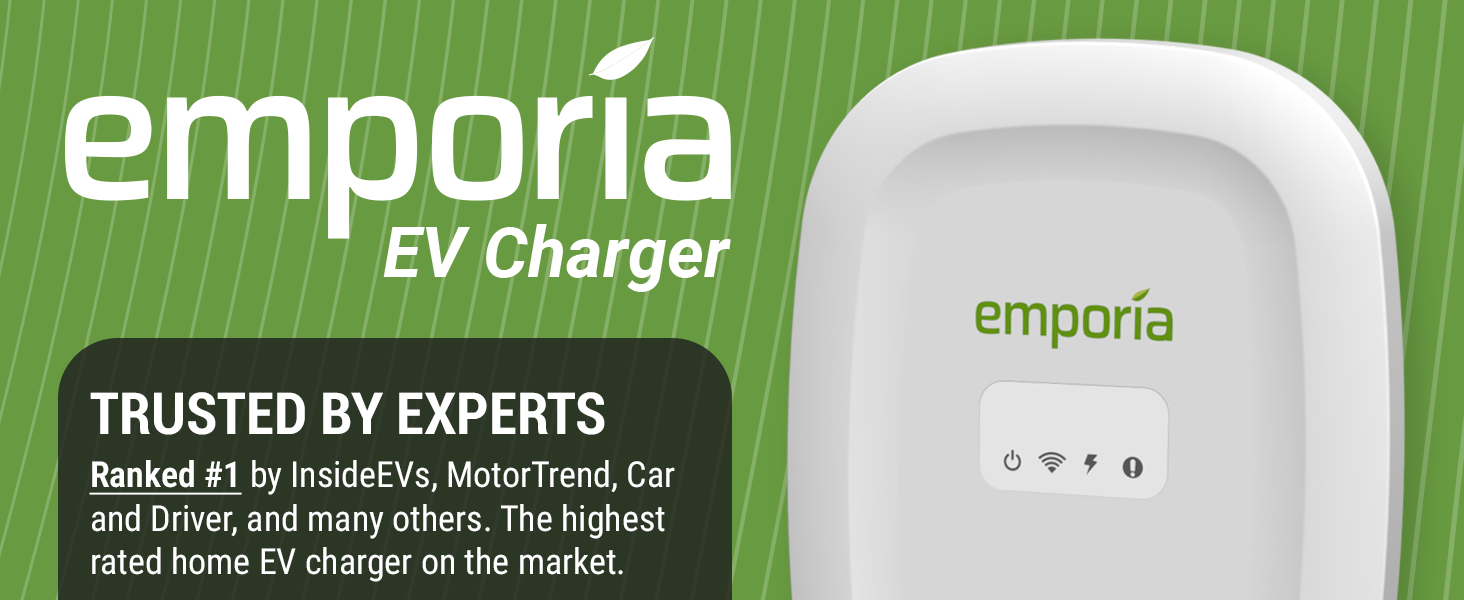
Yes. The Emporia Level 2 EV Charger is the best value smart charger on the market in 2026. It delivers up to 48 amps (11.5 kW) of charging power, works with both J1772 and NACS connectors, and includes WiFi-enabled smart charging with energy monitoring, all for approximately $399 to $449. Named “Best Level 2 EV Charger” by MotorTrend, InsideEVs, and Car Talk, it outperforms chargers costing $200+ more.
The Emporia Level 2 EV Charger has earned its reputation as the top-rated home charging station under $500. With a 4.7-star average across 2,850+ Amazon reviews and endorsements from MotorTrend, InsideEVs, Car and Driver, and Good Housekeeping, it is the charger we recommend most often to new EV owners who want smart features without paying ChargePoint or JuiceBox prices.
In this review, we break down real-world charging performance, installation flexibility, smart app capabilities, safety certifications, and whether Emporia is the right charger for your specific vehicle and home setup.
| Feature | Emporia L2 | ChargePoint Home Flex | EVIQO L2 |
|---|---|---|---|
| Max Amperage | 48A (hardwired) / 40A (plug) | 50A | 40A |
| Max Power | 11.5 kW | 12 kW | 9.6 kW |
| Cable Length | 25 feet | 23 feet | 25 feet |
| WiFi & App | 2.4 GHz WiFi, free app | WiFi, Alexa/Google | WiFi, app |
| Connector | J1772 + NACS option | J1772 + NACS option | J1772 |
| Outdoor Rating | NEMA Type 4 (IP66) | NEMA 3R | NEMA 4 |
| ENERGY STAR | Yes | Yes | Yes |
| UL Certified | Yes | Yes | Yes |
| Warranty | 3 years | 3 years | 3 years |
| Approx. Price | $399 to $449 | $599 to $699 | $379 to $399 |
| Amazon Rating | 4.7/5 (2,850+ reviews) | 4.3/5 (5,200+ reviews) | 4.6/5 |
As the table shows, Emporia matches or beats the competition on nearly every metric, while costing $150 to $250 less than the ChargePoint Home Flex. The only area where ChargePoint wins is maximum amperage (50A vs 48A), but in practice, most EVs accept at most 48A from a Level 2 charger, so the difference is negligible for most drivers.
The Emporia charger operates in two modes depending on your installation method:
When hardwired directly into your electrical panel by a licensed electrician, the Emporia delivers its maximum 48 amps of output, adding approximately 38 to 46 miles of range per hour depending on your vehicle’s onboard charger. This is among the fastest home charging speeds available in 2026.
To put that in perspective: a Tesla Model Y Long Range with a 75 kWh battery can go from 20% to 80% in about 5 hours. A Ford Mustang Mach-E Extended Range would charge from empty to full in roughly 8 hours overnight.
If you already have a NEMA 14-50 outlet installed (common in newer homes and garages), the plug-in version delivers 40 amps, adding about 28 to 38 miles of range per hour. While slightly slower than hardwired mode, this is still fast enough for most daily driving needs and offers the advantage of easy removal if you move.
| Vehicle | Onboard Charger | Miles/Hour (48A) | Miles/Hour (40A) |
|---|---|---|---|
| Tesla Model Y | 11.5 kW | ~44 mph | ~36 mph |
| Ford Mustang Mach-E | 11.2 kW | ~42 mph | ~35 mph |
| Chevy Bolt EUV | 11.0 kW | ~41 mph | ~34 mph |
| Hyundai IONIQ 5 | 10.9 kW | ~40 mph | ~33 mph |
| Rivian R1S/R1T | 11.5 kW | ~46 mph | ~38 mph |
| Nissan Leaf | 6.6 kW | ~25 mph | ~25 mph |
Note: The Nissan Leaf has a smaller onboard charger (6.6 kW), so it cannot take full advantage of the Emporia’s 48A output. If you drive a Leaf, a 32A charger would be sufficient.
One of Emporia’s biggest strengths is its installation flexibility. The charger ships in one of two configurations, and you can choose based on your home’s electrical setup:
If your garage or carport already has a 240V NEMA 14-50 outlet (the same type used for electric dryers and RVs), installation is as simple as mounting the charger to the wall and plugging it in. This is the fastest path to charging and allows you to take the charger with you if you move.
Important GFCI note: The National Electrical Code (NEC) now requires GFCI breakers on NEMA 14-50 circuits. Since the Emporia charger has its own built-in GFCI protection, this can cause “nuisance tripping” where the breaker trips unexpectedly. If your panel has GFCI breakers on the 14-50 circuit, Emporia recommends switching to the hardwired model instead.
For maximum performance (48A) and to avoid GFCI tripping issues, hardwiring is the recommended installation method. A licensed electrician runs a dedicated 60-amp circuit from your panel to the charger location. This typically costs $300 to $700 for the electrical work, depending on panel distance and local rates.
For a complete installation cost breakdown, see our Level 2 EV Charger Installation Guide.
The Emporia charger features a NEMA Type 4 enclosure, which is watertight and suitable for both indoor and outdoor installation. This rating exceeds the NEMA 3R rating found on many competitors, meaning the Emporia can handle direct water spray, dust, and temperatures from -22 degrees Fahrenheit to 122 degrees Fahrenheit (-30 degrees Celsius to 50 degrees Celsius).
The 25-foot charging cable is one of the longest in its price class. For comparison, the ChargePoint Home Flex has a 23-foot cable, and many budget chargers only offer 18 to 21 feet. The extra length matters if your parking spot is far from the charger mount point.
The charger body is made of a durable plastic polymer. While it is not as rugged as the steel enclosure on the Grizzl-E Classic, the plastic construction keeps the unit lightweight and weatherproof. The included metal connector holster is sturdier than the plastic holsters found on competing chargers and holds the J1772 connector securely.
One minor complaint from some users is that the power cord is thick and somewhat inflexible, which can make routing it along walls a bit challenging. Plan your mount location carefully to minimize cable bending.
The Emporia charger connects to your home network via 2.4 GHz WiFi and is controlled through the free Emporia mobile app (available for iOS and Android). The app is one of the strongest reasons to choose Emporia over a non-smart charger.
The app does require creating a free Emporia account, which some users find unnecessary for a charger that could theoretically operate without internet. However, the account requirement enables cloud-based scheduling and remote monitoring, which are genuine value-adds for most owners.
It is worth noting that the charger supports only 2.4 GHz WiFi, not 5 GHz. This is standard for smart home devices (the lower frequency has better range through walls) but may be a limitation if your router only broadcasts on 5 GHz. A simple WiFi extender or enabling the 2.4 GHz band on a dual-band router resolves this.
The Emporia charger carries an impressive list of safety certifications, especially for its price point:
These certifications are significant for two reasons. First, they ensure the charger meets rigorous safety standards for electrical equipment. Second, many state and utility rebate programs require ENERGY STAR certification, meaning the Emporia may qualify for rebates that effectively reduce your purchase price. Check our EV Charger Rebates by State guide to see if you qualify.
The Emporia charger uses the SAE J1772 connector, which is compatible with every electric vehicle sold in North America except older Tesla vehicles (which require a J1772-to-Tesla adapter, typically included with the vehicle). For newer Tesla vehicles with NACS connectors, Emporia offers a dedicated NACS version.
| Brand | Models |
|---|---|
| Tesla | All models (with J1772 adapter or NACS version) |
| Chevrolet | Bolt EUV, Bolt EV, Volt, Silverado EV, Equinox EV |
| Ford | Mustang Mach-E, F-150 Lightning, E-Transit |
| Hyundai | IONIQ 5, IONIQ 6, Kona Electric |
| Kia | EV6, EV9, Niro EV |
| Volkswagen | ID.4, ID.Buzz |
| Nissan | Leaf, Ariya |
| BMW | i3, i4, iX, i5 |
| Audi | e-tron, Q4 e-tron, Q8 e-tron |
| Rivian | R1S, R1T, R2, R3 |
| Jeep | Wrangler 4xe, Grand Cherokee 4xe |
The Emporia Level 2 EV Charger typically retails between $399 and $449 on Amazon, depending on the configuration and any active promotions. At this price point, it competes directly with the EVIQO L2 (approximately $379) and significantly undercuts the ChargePoint Home Flex ($599 to $699).
For the features you get, 48A charging, WiFi smart app, UL and ENERGY STAR certifications, a 25-foot cable, NEMA Type 4 outdoor enclosure, and a 3-year warranty, the Emporia represents the best price-to-feature ratio of any home EV charger we have tested.
For budget-conscious buyers, also check our Best Budget EV Chargers Under $400 guide for additional options.
The Emporia Level 2 EV Charger is our top recommendation for most EV owners. It hits the sweet spot of performance, features, safety, and price that no other charger in 2026 can match.
Related: Looking for portable charging options? Check out our complete guide to the best portable EV chargers for detailed recommendations and comparisons.
Yes. The Emporia J1772 connector works with Tesla vehicles using the J1772 adapter that comes with every Tesla. For newer Tesla models with NACS connectors, Emporia offers a dedicated NACS version (ASIN B0CKKLCVSR) that connects directly without an adapter. The NACS version also includes a UHF sensor that automatically opens the Tesla charge port.
The NEMA 14-50 plug version is limited to 40 amps (9.6 kW) and requires a 50-amp breaker. The hardwired version can deliver 48 amps (11.5 kW) and requires a 60-amp breaker. The plug version is easier to install and portable, while the hardwired version is faster and avoids GFCI tripping issues.
Yes, the charger will function for basic plug-and-charge operation without WiFi. However, smart features like scheduling, energy monitoring, and remote control require a WiFi connection and the Emporia app. Firmware updates also require WiFi.
The cable is 25 feet (approximately 7.6 meters) long, making it one of the longest cables in its price category. This provides flexibility for mounting the charger on a garage wall and reaching vehicles parked in different positions.
Yes. The Emporia charger has a NEMA Type 4 enclosure, which is watertight and rated for outdoor use. It operates in temperatures from -22 degrees F to 122 degrees F. This rating exceeds the NEMA 3R rating on many competing chargers.
The charger is ENERGY STAR certified and UL Listed, which are common requirements for state and utility rebate programs. Many states offer rebates of $100 to $500 for ENERGY STAR-certified EV chargers. Check our EV Charger Rebates by State guide for specific programs in your area.
The Emporia Level 2 EV Charger comes with a 3-year warranty from the manufacturer. Emporia is based in Littleton, Colorado, and provides US-based customer support. Many users report that Emporia’s support team goes beyond standard warranty procedures to help resolve issues.
For a detailed comparison with the Tesla Wall Connector, see our Tesla Wall Connector review.
Other premium options: If you want alternatives to the Emporia, the Wallbox Pulsar Plus 48A and Autel MaxiCharger Home both offer higher build quality and advanced features like load management.
See how Emporia stacks up against ChargePoint in our Emporia vs ChargePoint comparison.See also: Grizzl-E review
See also: How much will charging cost you? Our complete EV charging cost guide breaks down electricity rates by state.
Lorem Ipsum is simply dummy text of the printing and typesetting industry
Complete guide to EV charger load management: dynamic load balancing, power sharing, static allocation. Wallbox, Autel, Emporia. Avoid panel upgrades...
Best Level 1 EV chargers for 120V outlet charging. Lectron dual-voltage, Tesla Mobile Connector, Emporia. Tips, costs, safety, when to...
Complete guide to scheduling EV charging: TOU rates, smart charger apps, solar surplus charging, cost savings calculator. Emporia, Wallbox, ChargePoint...




