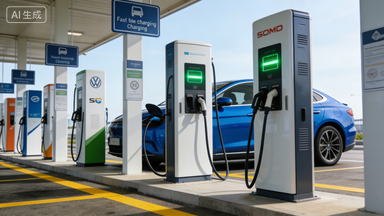
This guide explains advanced EV charger features, performance considerations, and a few unusual scenarios that drivers and site owners sometimes ask about. Content is written for real-world decision-making and aligns with current industry practices.
View Recommended Level 2 Home EV Chargers on AmazonA V2G (Vehicle-to-Grid) EV charger is a bi-directional charging system that can both charge your EV and send power back from the vehicle battery to the grid or a building. Unlike traditional one-way chargers, V2G systems communicate with the utility or energy-management platform to:
• Discharge energy during peak demand (grid support)
• Store excess renewable energy (solar/wind) in the EV battery
• Provide backup power to a home or facility (when integrated with proper transfer equipment)
V2G requires:
• A bi-directional charger
• A V2G-capable vehicle and battery-management system
• Utility or aggregator participation and appropriate interconnection agreements
Level 2 chargers operate on 208–240V AC and typically range from 16A to 80A. The fastest residential/commercial Level 2 units deliver:
• Up to 19.2 kW (80A at 240V) in ideal conditions
• Real-world charging rates often limited by the vehicle’s onboard charger (many EVs accept only 7.2–11.5 kW)
For most homes, a 32A–48A Level 2 charger (7.7–11.5 kW) is the practical maximum, balancing panel capacity, wiring cost, and charge speed.
Different charging speeds serve different use cases:
Slow / Level 1 (120V):
• Low power draw, easy to plug into standard outlets
• Suitable for overnight charging with low daily mileage
• Minimal impact on electrical infrastructure
Level 2 (Home & Destination):
• Ideal for daily home, workplace, and public “park-and-charge” use
• Fully replenish most EVs overnight or during a workday
DC Fast Charging (Highway / Corridor):
• Designed for road trips and long-distance travel
• High instantaneous demand on the grid and higher equipment cost
A healthy charging ecosystem combines all three: slow, moderate, and fast charging options, optimised for dwell time, cost, and grid impact.
The most powerful EV chargers today are high-power DC fast chargers used on highways and fleet depots. They can deliver:
• Up to ~350 kW in many commercial deployments
• Very high current (often 300–500A) at high voltage platforms (400V–800V and beyond)
These units are large, liquid-cooled, require substantial grid connections or on-site storage, and are not intended for residential use.
For homes, the “most powerful” practical option is a high-amperage Level 2 charger in the 48A–80A range, subject to panel capacity
and local code.
For most homeowners, a well-designed, certified Level 2 charger offers the best balance of speed, cost, and long-term reliability:
Check Home Level 2 Charger Options →
No. Installing an EV charger in or under water is strictly prohibited and violates electrical codes and basic safety principles.
EVSE must be:
• Mounted on solid structures above water level
• Installed according to clearance, GFCI, and bonding requirements
• Protected against splash and rain using appropriate NEMA/IP ratings
Pool areas often have additional code restrictions because of increased shock risk. Chargers may be installed near pool areas only
when explicitly designed and permitted, with strict adherence to distances, bonding, and GFCI requirements.
Cable and connector theft is a real concern in some regions, especially for public or unattended sites. Several strategies exist:
• Integrated locking holsters: The connector locks into a dock when not in use, making casual theft more difficult.
• Retractable or overhead cable systems: Cables retract into a mast or enclosure, reducing tampering.
• Authentication before energizing: User must start a session via RFID/app; cable is useless without power.
• Hardwired cables + tamper-resistant fasteners: Make removal time-consuming and conspicuous.
For high-risk areas, site hosts may consider locked enclosures, surveillance, and well-lit locations. Locking sockets are part of
a broader security design, which should also consider uptime, maintenance, and user convenience.
Lorem Ipsum is simply dummy text of the printing and typesetting industry
2026 Rivian R2 & R3 Home Charging Guide: Everything You Need to Know Affiliate Disclosure: EVChargerExperts is supported by its...
# 2026 Rivian R2 & R3 Home Charging Guide: Everything You Need to Know *Affiliate Disclosure: EVChargerExperts is supported by...
*Affiliate Disclosure: EVChargerExperts is supported by its audience. When you buy through links on our site, we may earn an...




