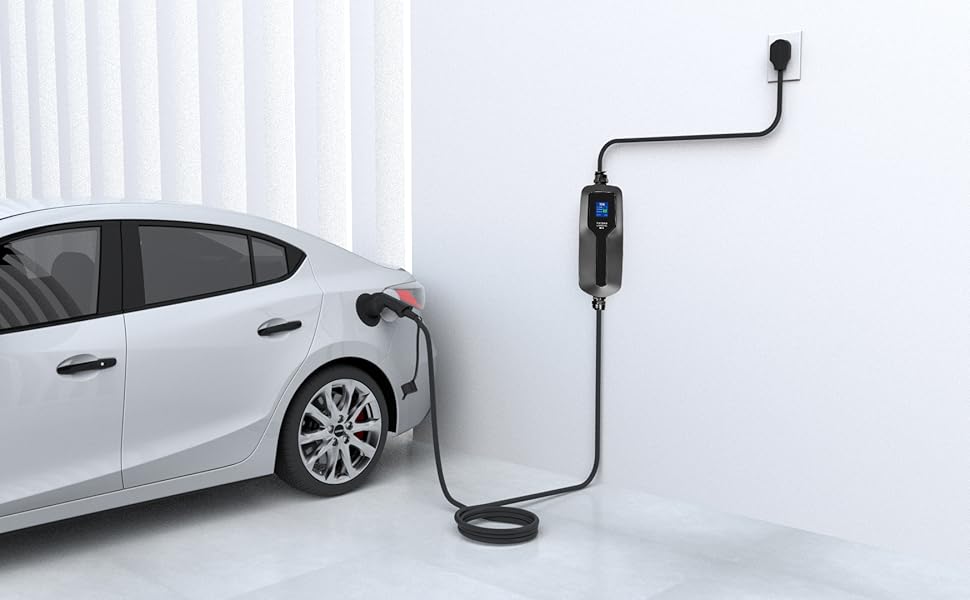
A NEMA 10-30 portable Level 2 EV charger, 30A with a 25ft cable targets a very specific household: one with a pre-1996 electric dryer outlet and no budget or permission to rewire. It promises real Level 2 speed from an existing socket, and for some homes that is genuinely useful. But this is also the one charger category where we urge extra care, because the 10-30 receptacle was designed before modern grounding rules and the marketing wattage does not quite line up with the circuit math. This review covers both. If you have decided this configuration is right for you, see the NEMA 10-30 charger on Amazon.
EV charging equipment relies on ground-fault protection and a sound grounding path as part of its safety design. A charger built specifically for 10-30 may use the neutral as its reference, which is how old dryers worked, but that arrangement is not equivalent to a modern grounded circuit and is not acceptable in all jurisdictions or to all inspectors. Before buying, have a licensed electrician look at the actual receptacle and the panel behind it. Our safety guide explains why this check is non-negotiable.
Here is the arithmetic worth doing before you order. A 6.6 kW draw at 240V requires about 27.5A. The National Electrical Code treats EV charging as a continuous load, so a 30A branch circuit may only supply 24A continuously, which is about 5.8 kW. In other words, a headline 6.6 kW is not a sustained, code-compliant output on a 30A circuit; the realistic continuous figure is closer to 5.5 to 5.8 kW. Some listings quote 220V or a peak rating, which explains part of the gap. The practical takeaway is simple: expect roughly 18 to 22 miles of range per hour, not a 6.6 kW-class 30-plus miles.
| Configuration | Continuous power | Range / hour |
|---|---|---|
| 24A on a 30A circuit | ~5.8 kW | ~18 to 22 mi |
| 16A reduced setting | ~3.8 kW | ~11 to 13 mi |
| Standard 120V Level 1 | ~1.4 kW | ~4 to 5 mi |
Even at the honest number, an overnight session comfortably restores a typical daily commute. That is the real value here: not maximum speed, but a large step up from a wall outlet without a new circuit.
If the wiring behind the outlet includes a ground or can be re-run, converting to a four-prong NEMA 14-30 is usually a modest job for an electrician and removes the grounding question entirely. From there, a modern adjustable charger like the Splitvolt 14-30 charger is the cleaner long-term answer, and it works with the same 24A continuous ceiling. If the dryer and car need the outlet at the same time, a listed smart splitter such as the one in our VEVOR splitter review handles the switching automatically. Our installation cost guide covers what a dedicated circuit or receptacle upgrade typically involves.
For most buyers, choosing hardware for a modern grounded circuit is the better decision. The Emporia and ChargePoint Home Flex are hardwired or 14-50 smart units. The MACH 3 40A portable is the high-power NEMA 14-50 option, and the 16A dual-voltage portable needs nothing more than a standard outlet. Our portable charger roundup compares them all against real household wiring.
A 25ft cable is genuinely helpful in older garages, where the dryer outlet is often in a utility room rather than next to the parking spot. Route the cable so it is not pinched by a door, dragged across a walkway, or left in standing water, and keep the control box off the floor. In cold weather, dry the connector before plugging it in and coil the cable loosely to avoid stressing a stiff jacket. Store the unit indoors between uses; portable does not mean permanently exposed.
Electricity cost does not change with the outlet: roughly $0.16 per kWh, so a 60 kWh fill is around $10 whether it takes four hours or ten. The saving comes from avoiding public charging, not from this particular receptacle. Where the 10-30 unit can save money is on installation, since it uses what is already there; where it can cost money is if the old circuit needs remediation anyway. Get an electrician’s quote for a 14-30 conversion before deciding, and compare with the numbers in our cost guide.
Beyond the physics, there is a paperwork dimension. Some insurers and home inspectors take a dim view of EV charging on an ungrounded three-prong circuit, and a future buyer’s inspector may flag it. A permitted upgrade to a grounded receptacle or a dedicated circuit avoids that ambiguity and is generally viewed as a positive feature when selling a home with an EV charger. If you plan to stay in the house for years, the upgrade usually pays for itself in clarity alone. Our installation guide explains the permit and inspection steps involved.
A NEMA 10-30 portable charger delivers useful overnight Level 2 speed from an outlet many older homes already have, and the 25ft cable suits awkward garage layouts. But the missing equipment ground and the inflated 6.6 kW headline mean it should be a considered choice, not an impulse buy. Have the circuit inspected, expect roughly 5.8 kW continuous in practice, and seriously price a 14-30 conversion first. If you proceed, use the NEMA 10-30 charger exactly as listed; otherwise step up to our verified modern-standard picks and the splitter guide for shared outlets.
The identification takes ten seconds and prevents an expensive mistake. A NEMA 10-30 has three slots: two angled hot slots and one L-shaped or straight neutral slot. A NEMA 14-30 has four: two hots, a neutral and a round or U-shaped ground. A NEMA 14-50, common for RVs and high-power garage circuits, has a different blade pattern again and supports a 50A circuit. Photograph the receptacle and the breaker label before shopping, and show both to the electrician. Adapting a plug to force a match is never the answer, since the breaker, wire gauge and grounding path behind the wall are what actually determine what is safe. Our Level 1 versus Level 2 guide helps frame how much power you need before you commit to any circuit work.
Lorem Ipsum is simply dummy text of the printing and typesetting industry
Complete guide to EV charger load management: dynamic load balancing, power sharing, static allocation. Wallbox, Autel, Emporia. Avoid panel upgrades...
Best Level 1 EV chargers for 120V outlet charging. Lectron dual-voltage, Tesla Mobile Connector, Emporia. Tips, costs, safety, when to...
Complete guide to scheduling EV charging: TOU rates, smart charger apps, solar surplus charging, cost savings calculator. Emporia, Wallbox, ChargePoint...




