A professional guide to J1772 ↔ Tesla (NACS) and CCS adapters
As electric vehicle charging standards continue to coexist globally, charging adapters (转接头 / Adapter) play a critical role in interoperability. Adapters allow vehicles and charging stations built around different connector standards to work together safely and effectively. This article focuses on the most commonly searched and practically relevant adapter types, including J1772 to Tesla, Tesla to J1772, NACS to CCS, and other Tesla charging adapters.
An EV charging adapter is a certified intermediary device that mechanically and electrically maps one charging connector standard to another.
Contrary to common assumptions, adapters do not increase charging speed or voltage. Instead, they ensure:
Adapters are especially important in regions where J1772, NACS (Tesla), and CCS infrastructure overlaps.
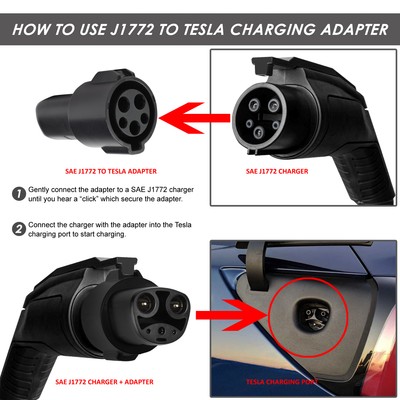
A J1772 to Tesla adapter (also written as j1772-to-tesla adapter or tesla j1772 adapter) allows a Tesla vehicle to charge from a J1772 EV charger, most commonly a Level 2 AC charger.
This is one of the most widely used EV charging adapters in North America.
You need this adapter if:
This scenario is extremely common at:
No. Charging speed is still determined by:
The adapter only enables compatibility; it does not change power characteristics.
A Tesla to J1772 adapter allows non-Tesla electric vehicles to charge from Tesla Level 2 chargers, such as wall-mounted AC units.
This adapter is increasingly relevant as Tesla charging hardware becomes more common in residential and commercial environments.
No. Tesla to J1772 adapters are intended for AC Level 2 charging only. They do not enable access to DC fast charging systems.
In practice, they are used with:
A NACS to CCS adapter (often searched as tesla to ccs adapter) enables vehicles using Tesla’s connector system to access CCS DC fast chargers, or vice versa depending on vehicle and market configuration.
This adapter category is directly tied to DC fast charging, not AC charging.
They address a critical interoperability gap:
By using a Tesla to CCS adapter, drivers can significantly expand their fast-charging options, especially in regions where CCS infrastructure is more prevalent.
No. These adapters are designed for public DC fast charging stations. They operate at high power levels and require strict thermal and electrical protections.
The term Tesla charging adapter is a broad category that may include:
Each adapter type serves a specific charging scenario, and they are not interchangeable.
When properly certified and used within their rated limits, Tesla charging adapters are designed to meet:
Users should always verify:
| Adapter Type | Charging Level | Typical Use Case |
|---|---|---|
| J1772 to Tesla adapter | Level 1 / Level 2 AC | Tesla charging from J1772 EVSE |
| Tesla to J1772 adapter | Level 2 AC | Non-Tesla charging from Tesla AC chargers |
| NACS to CCS adapter | DC fast charging | Tesla ↔ CCS public fast chargers |
| Tesla charging adapter (general) | AC or DC | Broad category covering multiple scenarios |
As EV infrastructure continues to evolve and standards converge, charging adapters remain a critical transitional solution, enabling flexibility, investment protection, and broader access across charging networks—including those operated or influenced by Tesla.
Lorem Ipsum is simply dummy text of the printing and typesetting industry
2026 Rivian R2 & R3 Home Charging Guide: Everything You Need to Know Affiliate Disclosure: EVChargerExperts is supported by its...
# 2026 Rivian R2 & R3 Home Charging Guide: Everything You Need to Know *Affiliate Disclosure: EVChargerExperts is supported by...
*Affiliate Disclosure: EVChargerExperts is supported by its audience. When you buy through links on our site, we may earn an...




