EV Charging Technology & Compatibility: How It Really Works
This page explains how electric vehicle charging stations work, which plugs and standards are used,
how compatible they are across brands, and what you should know about hybrids, solar, HOAs and 12V systems.
The goal: clear, reliable answers you can trust — without the engineering jargon.
Explore Popular Home & Portable EV Chargers on Amazon Affiliate disclosure: if you purchase through this link, we may earn a small commission at no extra cost to you.
1. How Electric Vehicle Charging Stations Work
How do electric vehicle charging stations work?
Most EV charging stations are essentially
smart power outlets designed for vehicles:
- The station communicates with the car over a control pilot signal built into the connector.
- The station tells the car how much current is available (e.g., 16A, 32A, 40A, 48A).
- The car’s onboard charger (for AC charging) decides how much power to draw within that limit.
- For DC fast chargers, the station provides high-voltage DC directly to the battery, with continuous communication to control voltage, current, and temperature.
Safety systems (ground fault detection, overcurrent, temperature sensors) constantly monitor the session and stop charging if something looks unsafe.
How do electric vehicle charging stations work and where can they be found?
Technically they work the same way described above. You can typically find them:
- At homes and apartments (Level 1 & Level 2)
- Workplaces and offices
- Shopping centers, hotels, and restaurants
- Highway rest stops and service plazas (often with DC fast chargers)
- Public parking garages and municipal lots
Navigation apps, in-car navigation, and charger network apps (like ChargePoint, Tesla, etc.) aggregate these locations for drivers.
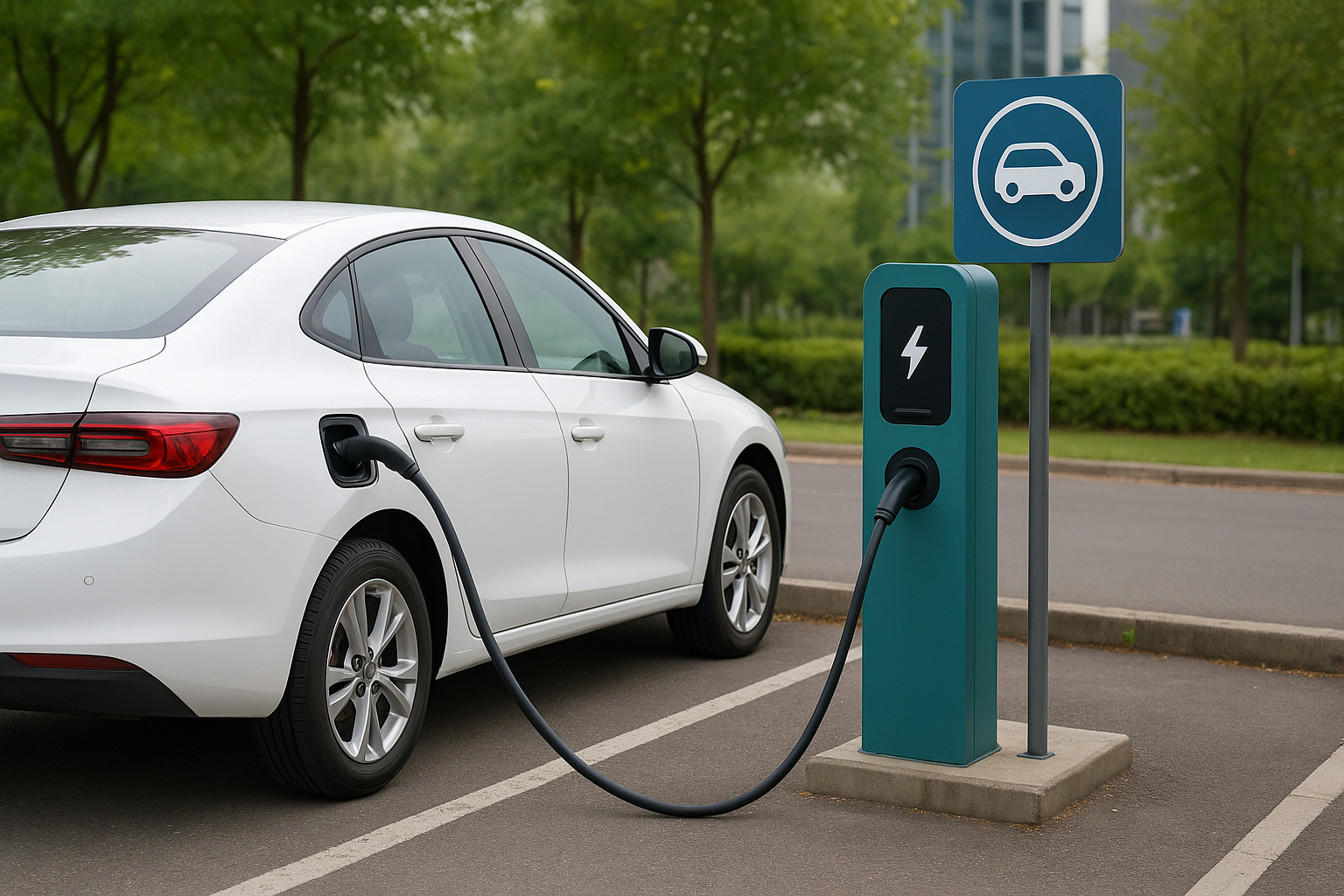
How do electric car charging stations work? (Quick summary)
In one sentence: a charging station is a smart, safety-controlled power supply that negotiates with your EV
and delivers either AC (for the car’s onboard charger) or DC (directly into the battery), within safe electrical limits.
2. Plugs, Standards & Compatibility
Are all electric vehicle charging stations compatible with all makes of EVs?
Not exactly, but
most can be used with the right connector or adapter.
- North America AC (Level 1 & 2): SAE J1772 plug is standard for non-Tesla; Tesla uses NACS but often includes an adapter.
- North America DC: CCS1 and NACS are becoming dominant; CHAdeMO is being phased out.
- Europe: Type 2 (Mennekes) for AC; CCS2 for DC.
So compatibility depends on:
- The plug on the station
- The inlet on the car
- Whether you have the appropriate adapter (e.g., J1772–>Tesla or NACS–>CCS)
Do EV charging stations have proprietary plugs, or can any EV use any station?
Historically, some automakers used more proprietary plugs, but the industry is rapidly converging on a few open standards:
- J1772 (SAE): Standard AC plug for most North American non-Tesla EVs.
- NACS (Tesla / J3400): Tesla’s compact connector, now adopted by many OEMs in North America.
- CCS: Adds DC pins to the AC plug for fast charging.
Many modern stations offer **a common standard plus adapters**, so with the proper adapter, most EVs can use most stations.
What is the most common type of electric vehicle charging station?
Globally, the most common is still
AC Level 2 (or the equivalent 7–22 kW AC in other regions).
It’s the sweet spot for:
- Home garages and driveways
- Workplaces and destination charging
- Hotels, malls, and public car parks
DC fast charging is less common but critical on highways.
3. Grid Connection & Load Management
Do electric vehicle charging stations need to be connected to the grid?
Most do, yes. The vast majority of chargers draw power from the electrical grid. However, there are exceptions:
- Solar-powered stations with battery storage can reduce grid dependence.
- Some remote chargers use off-grid systems, but they are relatively rare.
Even solar sites are usually grid-tied to balance intermittent generation.
How should EV charging stations be designed to reduce impact on the distribution system?
Good design minimizes stress on the local grid by:
- Smart load management: dynamically limits total site power and shares it among chargers.
- Time-of-use awareness: encouraging charging during off-peak hours with price signals.
- Staggered charging: not all chargers at full power at the same time.
- On-site storage: batteries can buffer demand peaks and smooth power draw.
- Right-sizing: choosing realistic charger counts and power levels for the location.
For large sites, utilities often perform studies and may upgrade transformers or feeders to maintain reliability.
4. HOAs, Apartments & Legal Adaptation
How are HOAs adapting to residents installing personal EV charging stations or solar panels?
Practices vary by country and state, but the general trend is:
- More regions adopt “right-to-charge” laws that limit an HOA’s ability to unreasonably block EV chargers.
- HOAs often create standard guidelines:
- Who pays for installation and electricity
- Approved equipment types and locations
- Requirements for licensed electricians and permits
- Some buildings install shared chargers in visitor or common parking areas.
If you live under an HOA, always check:
- Local laws about EV charging rights
- HOA bylaws and architectural rules
5. “Charging Pile” vs “Charging Station”
What is the difference between an electric vehicle charging pile and a charging station?
In many translations and markets:
- Charging pile often refers to a single physical charging unit (one pedestal or wallbox).
- Charging station usually means a site with multiple charging piles, plus supporting infrastructure:
- Transformers and switchgear
- Metering and load management systems
- Networking and payment systems
In everyday English, people often just say “charging station” for both.
6. Solar-Powered EV Charging
Do electric vehicle charging stations have solar panels?
Some do, but most do not yet. There are three common setups:
- Grid-only: the most common; all energy comes from the utility grid.
- Solar + grid-tied: rooftop or canopy solar helps offset energy use; excess goes to or from the grid.
- Solar + battery + charger (partial off-grid): useful in remote locations or where the grid is weak.
Solar reduces operational carbon footprint but doesn’t remove the need for solid electrical design and, often, grid backup.
7. 12V Systems, Camper Batteries & Hybrids
Can I charge my 100Ah 12V lithium campervan batteries using an EV charging station?
Not directly. An EV charging station:
- Outputs either AC (120/240V) or high-voltage DC (hundreds of volts) designed for EVs.
- Your camper batteries need a 12V battery charger or a DC–DC converter designed for that purpose.
You can:
- Use a **Level 2 station** to power a properly rated **AC-to-DC charger** that charges your 12V bank.
- Or use appropriate DC–DC hardware if your system supports it.
But you should
never try to connect an EVSE output directly to a 12V battery bank; this is unsafe and will damage equipment.
What happens if you plug in a hybrid car to an EV charging station?
It depends on the hybrid type:
- Plug-in hybrids (PHEVs) – These are designed to charge from EV stations. They typically accept:
- Level 1 (120V) and Level 2 (240V) AC charging
- Sometimes DC fast charging, depending on the model
- Conventional hybrids (HEVs) – e.g., older Prius without a charge port:
- They cannot charge from external EV chargers at all.
- If they don’t physically have a charge inlet, you can’t plug them in.
If your hybrid has a J1772 or NACS/Type 2 inlet and the manual states it supports external charging, you can safely use EV stations within the charger and car’s limits.
Use real-world products and specs to better understand connector types, power ratings, and smart features before choosing your own charger.