
Home EV Charging: Installation & Everyday Residential Use

Home EV charging is now the most common and cost-effective way for electric vehicle owners to recharge. Below is a practical, professional guide answering the most common real-world questions about installing and using EV chargers at home.

Can you build your own EV charger station in your garage?

You can set up a personal charging station at home, but you should not build an EV charger from scratch. EV chargers (EVSE) contain safety logic, ground-fault detection, and communication protocols that must meet electrical codes.

The correct approach is to install a certified EV charger (UL / ETL listed) using either a plug-in outlet or hardwired connection.

How do you hook up an EV charger at home?

  • Choose a Level 1 (120V) or Level 2 (240V) charger
  • Verify available outlet or electrical capacity
  • Mount charger on wall or pedestal
  • Plug into approved outlet or hardwire
  • Configure amperage and safety settings
Most homeowners choose Level 2 charging (240V) because it is 4–8× faster than a standard wall outlet.

Can most homes accommodate a second EV charger?

Yes—many modern homes can support two EV chargers, but it depends on:

  • Main service size (typically 200A preferred)
  • Existing electrical load
  • Use of load-balancing or smart chargers

Smart chargers can dynamically share power, allowing two vehicles to charge safely on one circuit.

Can we install an EV charger without upgrading wiring or the breaker box?

Sometimes. If your home already has:

  • An unused 240V outlet (NEMA 14-50 / 6-20)
  • Sufficient panel capacity

Then a plug-in Level 2 charger may be installed without upgrades. Older homes or higher-power chargers may require panel or wiring upgrades.

How do I install a home EV charging station?

  • Select charger and mounting location
  • Confirm outlet or hardwire requirements
  • Install breaker (if needed)
  • Mount charger securely
  • Test grounding, GFCI, and charging current

Can a residential EV charger be installed without professional hard-wiring?

Yes. Plug-in EV chargers (NEMA 14-50 / 6-20) are designed for homeowner installation, assuming:

  • The outlet is code-compliant
  • The circuit is properly rated
  • The charger amperage is correctly limited

Can I install a home EV charger myself or do I need an electrician?

You can install a plug-in charger yourself. You should hire an electrician if:

  • Running new wiring
  • Installing a new breaker
  • Hardwiring a charger
  • Upgrading the electrical panel
Professional installation improves safety, insurance compliance, and resale value.

How many EV chargers does a house need?

Most homes need one charger. Two chargers are useful when:

  • Two EVs drive daily
  • Charging schedules overlap
  • Vehicles require fast overnight turnaround

Is it better to hardwire or plug in an EV charger?

  • Hardwired: Higher power, cleaner install, more durable
  • Plug-in: Portable, easier install, renter-friendly

For most homeowners, a plug-in Level 2 charger is sufficient and flexible.

Can you plug in more than one EV charger at a time?

Yes, if your electrical system supports it. Load-sharing chargers are strongly recommended to avoid breaker overload.

Can you get an EV charger without a driveway?

Yes. Options include:

  • Garage installation
  • Shared parking with HOA approval
  • Cable management systems for curbside charging

Is it worth installing an EV charger if I don’t own an EV yet?

In many cases, yes. Benefits include:

  • Future-proofing your home
  • Higher resale appeal
  • Lower installation cost before demand increases
  • Eligibility for rebates or tax credits
Installing an EV charger today is similar to pre-wiring for solar or fiber internet—optional now, valuable later.

Bottom line:

Recommended Home Charger: ChargePoint HomeFlex Level 2 EV Charger

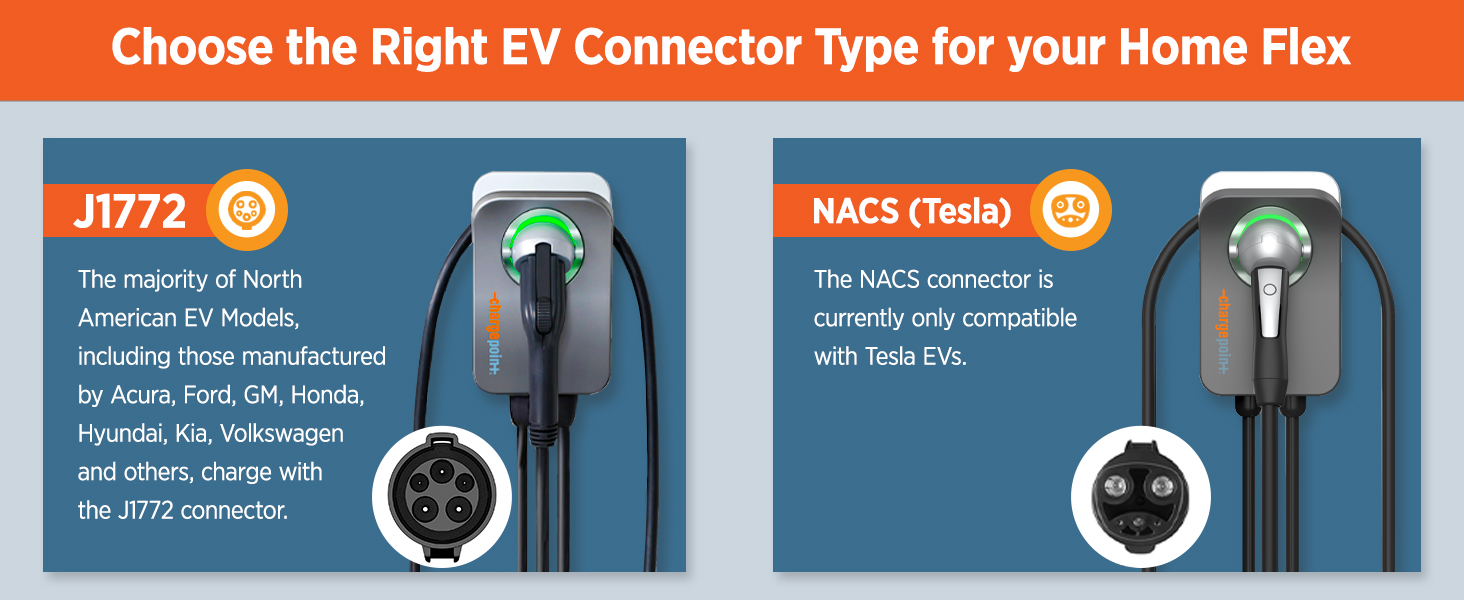
The ChargePoint HomeFlex Level 2 EV Charger is a premium hardwired home charging solution designed for drivers who want maximum speed, reliability, and access to one of the largest charging ecosystems in North America.

  • Fast Level 2 Charging: Delivers up to 9× faster charging than a standard 120V outlet, adding up to 45 miles of range per hour (vehicle dependent).
  • Universal J1772 Connector: Compatible with all non-Tesla EVs; Tesla vehicles can use it with a J1772-to-Tesla adapter.
  • Hardwired Installation: Designed for permanent indoor or outdoor installation by a licensed electrician.
  • Smart App Control: Manage charging schedules, reminders, energy usage, and station discovery through the ChargePoint mobile app.
  • Extensive Charging Network: Access over 274,000+ ChargePoint locations plus 565,000+ roaming partner stations across North America and Europe.
  • Certified & Durable: UL-certified with a cold-resistant cable for year-round outdoor use.
  • 24/7 Support: Backed by ChargePoint’s always-on customer service and proven commercial-grade reliability.

👉 View ChargePoint HomeFlex Level 2 EV Charger on Amazon

Best for: Homeowners who want a future-proof, app-connected Level 2 charger with access to a massive public charging network and professional-grade reliability.

Leave a Reply

Your email address will not be published. Required fields are marked *

Related Blogs

Lorem Ipsum is simply dummy text of the printing and typesetting industry

Lectron NEMA 14-50 Socket Splitter – Smart Power Sharing for Level 2 EV Chargi …

Lectron NEMA 14-50 Socket Splitter – Smart Power Sharing for Level 2 EV Charging & Home Appliances The Lectron NEMA...

Tesla Extension Cord 21ft (NACS) – 50A / 12kW High-Power EV Charging Extension …

Tesla Extension Cord 21ft (NACS) – 50A / 12kW High-Power EV Charging Extension for Model 3 / Y / S...

VEVOR J1772 EV Charger Extension Cable – 40A, 40ft, Level 1 & Level 2 (120 …

VEVOR J1772 EV Charger Extension Cable – 40A, 40ft, Level 1 & Level 2 (120V–240V) 4 The VEVOR EV Charger...
