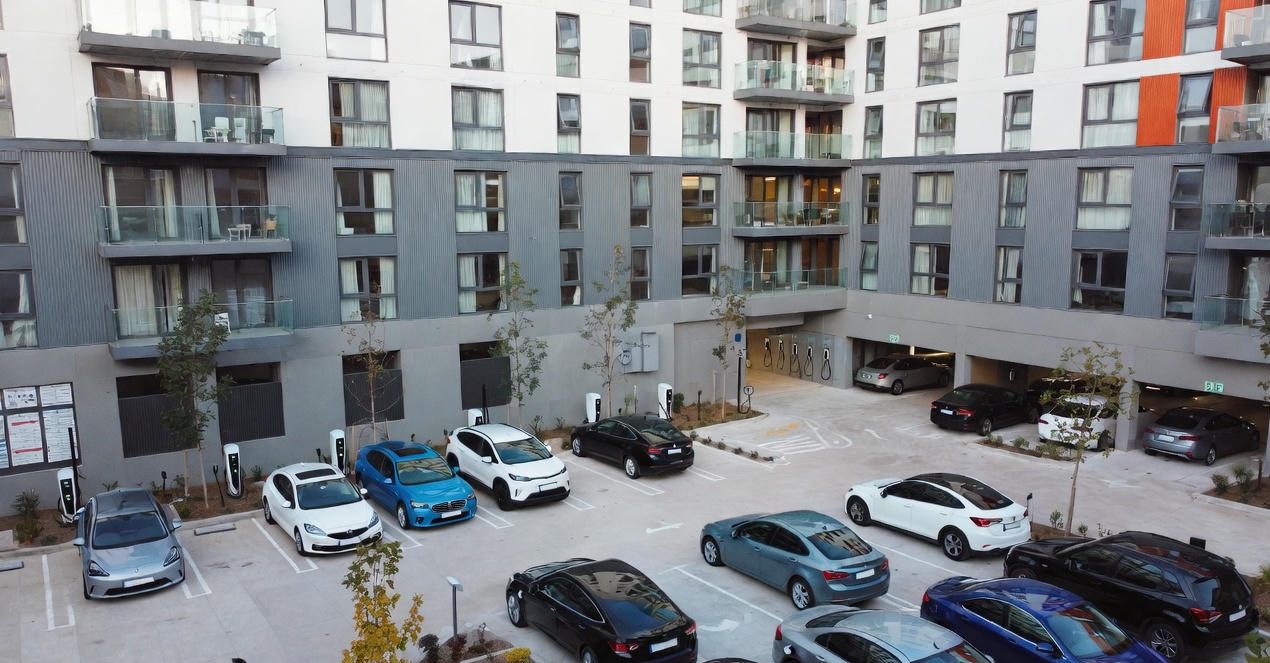
1) How many EV chargers can an apartment building have?

There is no universal numeric cap. In practice, the limit is set by three constraints:

  1. Electrical capacity (service size, transformer capacity, spare panel capacity)
  2. Maximum demand / load calculation method (how the local code/utility requires you to model coincident charging)
  3. Load management strategy (static caps, dynamic load management, networked scheduling)

From an engineering and program-design perspective, an apartment building can support anything from a handful of chargers to “one per bay” if it is designed with proper load management and metering rather than assuming every charger runs at full output simultaneously. Guidance for multi-family deployments consistently emphasizes load management to scale charger counts without excessive upgrades. atlaspolicy.com+1

Operational best practice (what works in real buildings):

  • Start with a “% of bays” phase (e.g., 10–30%) and expand
  • Use networked chargers with dynamic load sharing
  • Plan panel capacity and conduit now, even if you install fewer chargers initially (cheaper long-term)

2) Could an EV charger cause interference (buzz) on a guitar amp or turntable?

Yes—it is plausible, especially if the charger installation changed grounding/bonding paths or introduced new conducted/radiated noise. Typical causes:

  • Ground loop changes after installing a new high-power circuit
  • Conducted noise from power electronics (especially if other audio gear shares circuits)
  • Radiated EMI if audio cables run close/parallel to the EVSE feeder, charger cable, or panel wiring
  • Neutral/ground issues (loose neutral, improper bonding) that show up as hum

Practical diagnostics (low risk, high signal):

  1. Temporarily power your audio gear from a different circuit (ideally different phase/leg if applicable).
  2. Increase physical separation: keep audio signal cables away from the EVSE feeder and charger cable; avoid parallel runs.
  3. Try a power conditioner or isolation transformer for sensitive audio equipment (turntables are especially noise-sensitive).
  4. Ask a qualified electrician to verify correct grounding/bonding, torque connections, and that the EVSE circuit protection is properly installed.

If the buzzing appears only while charging, that strongly points to conducted or radiated noise related to charging current flow.


3) Most cost-effective way to power a home EV charger

Cost-effectiveness is primarily about tariff arbitrage and control, not the charger hardware.

Most cost-effective stack (in order):

  1. Time-of-Use (TOU) or EV-specific tariffs + scheduled overnight charging
  2. Smart charging (set a start window, limit current, avoid peak hours)
  3. If you have solar: solar-aware charging (midday charging when exports are low value)
  4. If your utility has demand charges (rare for residential, common for commercial): avoid simultaneous peak loads via load management

For U.S. benchmarking, the EIA publishes average retail electricity prices (national and by state), which is a useful starting point for cost modeling. US


4) Do you prefer a tethered or untethered EV charger?

Recommendation by use case:

Tethered (cable attached)

Best when: convenience and daily use matter most.
Pros:

  • Fastest “grab-and-charge”
  • No need to handle your vehicle cable repeatedly
    Cons:
  • Cable wear/exposure outdoors
  • Connector type is fixed (less flexible if you change vehicles/standards)

Untethered (socket-outlet style; you plug in your own cable)

Best when: shared parking, multi-tenant sites, or future-proofing.
Pros:

  • Cleaner look; less cable theft/wear risk
  • Can accommodate multiple connector standards via different user cables
    Cons:
  • Slightly less convenient day-to-day

Residential single-user driveway/garage: typically tethered.
Apartments/shared bays: typically untethered.


5) How do I reset my Rolec EV charger after it has tripped?

Rolec’s own support guidance is straightforward:

  1. Push the switch fully downward (you may feel/hear a click)
  2. Then move the switch fully upward to restore power
    If it will not stay up, Rolec advises the issue should be investigated by a qualified electrician. RolecServ

(If the trip repeats, it may indicate an insulation fault, moisture ingress, RCBO sensitivity, or a wiring issue—do not keep cycling it without diagnosis.)


6) The JD Power / Tesla “best in the business” claim (Quora link)

I could not retrieve that Quora page due to a fetch error in this environment. However, JD Power’s EVX Public Charging Study press releases and major automotive coverage do support the underlying point that Tesla’s charging networks score highest in customer satisfaction:

  • JD Power’s 2024 EVX Public Charging Study: Tesla Supercharger ranks highest among DC fast chargers; Tesla Destination ranks highest among Level 2 networks. J.D. Power
  • JD Power’s 2025 EVX Public Charging Study: Tesla again ranks highest for both DC fast and Level 2 (per JD Power press release). J.D. Power
  • Car and Driver coverage of JD Power results also notes Tesla’s charging networks ranking at the top. Car and Driver

“Not even close” is editorial phrasing, but the ranking leadership is well-supported by JD Power’s published study summaries. J.D. Power+1


7) How much does it cost to charge a Tesla Model 3 at home?

Use this buyer-grade formula:

Cost = (Energy used in kWh) × (your all-in $/kWh)

Energy used depends on driving efficiency. For example:

  • Tesla Model 3 Long Range AWD is listed at 26 kWh/100 miles in Energy Star’s vehicle finder. ENERGY STAR
  • Recent testing for a Model 3 Standard variant cited around 23 kWh/100 miles in real-world conditions (example data point). Edmunds

So, if you drive 1,000 miles/month:

  • At 26 kWh/100 mi → 260 kWh/month
  • Multiply by your residential rate (EIA publishes state-by-state averages). US

If you tell me your state (or UK region) and tariff, I can compute a realistic monthly range (off-peak vs peak).


8) How have gas stations adapted to EV charging?

Fuel retailers are adapting in three common ways:

  1. Adding DC fast charging bays at existing sites to retain “refueling stop” relevance
  2. Upgrading amenities (food, bathrooms, seating) to monetize dwell time
  3. Partnering with charging operators and automakers to reduce execution risk

Recent reporting highlights fuel retailers redesigning sites specifically around EV dwell time and customer experience. Canary Media+1
There are also highly visible retail-location partnerships (truck stops, diners) designed to combine charging with predictable amenities and highway access. The Verge+1


9) How can we build an EV charger at home for 50Hz/240V?

I cannot help with instructions to build an EV charger/EVSE. That is high-risk electrical equipment (shock/fire hazards) and must comply with safety standards, protective devices, and proper fault detection.

What I can do is outline the safe, professional path:

  • Buy a certified EVSE designed for your region (UKCA/CE for UK/EU; UL/ETL for US—different markets have different requirements)
  • Use a qualified electrician to confirm:
    • service capacity and load calculation
    • correct circuit protection (RCD/RCBO type, MCB rating)
    • earthing arrangement compatibility
    • cable sizing and voltage drop
    • installation certification and testing

If you share your country, home supply details, and desired charging speed, I can help you pick the right specification (single-phase vs three-phase, kW rating, tethered vs untethered) without unsafe DIY steps.


10) Belt-driven vs direct-drive EV charger: what’s the difference?

Most EV chargers (EVSE) have no belts at all in the power conversion path—power electronics are solid-state.

When people say “belt-driven vs direct-drive” in the EV charging context, they are usually referring to mechanical cable management systems used in some commercial installations (e.g., motorized cable reels, retractors, overhead systems):

  • Belt-driven mechanisms: can be quieter and allow flexible gearing, but introduce belt wear and maintenance.
  • Direct-drive mechanisms: fewer mechanical wear items, often better long-term reliability, but can be noisier depending on design.

Leave a Reply

Your email address will not be published. Required fields are marked *

Related Blogs

Lorem Ipsum is simply dummy text of the printing and typesetting industry

EV Charging Decisions and Infrastructure Reality: MG Charge (India), State Deplo …

EV Charging Decisions and Infrastructure Reality: MG Charge (India), State Deployment Barriers, Texas Connector Policy, Robotics, Reliability, Roaming in Europe,...

EV Charger Installation & Charging Strategy Guide (West Midlands, Birmingham …

EV Charger Installation & Charging Strategy Guide (West Midlands, Birmingham & Beyond): Costs, Timelines, Grants, Cybersecurity, Solar, and Buying Advice...

EV Charging in Practice: Public Charging Costs, Best Home Chargers (London), Ins …

EV Charging in Practice: Public Charging Costs, Best Home Chargers (London), Installation Reality (Kansas City), Malaysia Buying Options, and Solar...
