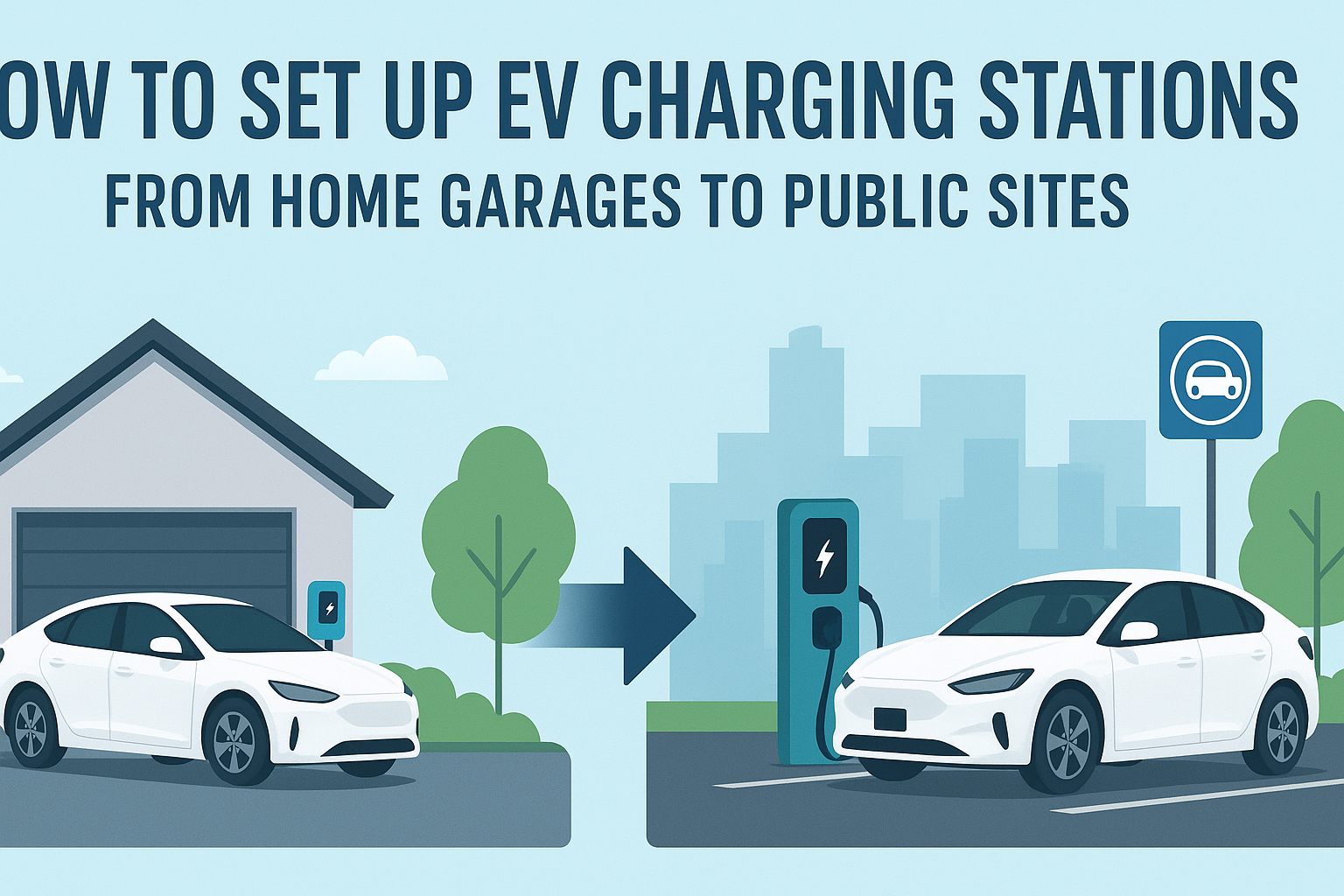
How to Set Up EV Charging Stations: From Home Garages to Public Sites
This guide explains, in clear steps, how to start an electric vehicle charging station – from a single
home charger in your garage to a public site with a dozen chargers.
We’ll cover setup, installation flow, key costs, permits, site selection, and common questions like using
dryer outlets or installing at home in India.
Quick Overview
- Home: usually 1× Level 2 charger + dedicated 240V circuit.
- Public: 4–12+ chargers, stronger grid connection, software + billing.
- Always use a licensed electrician and follow local electrical code.
Practical Starting Point
If you’re new to EV infrastructure, a good first step is installing a smart Level 2 charger at home
or a small private site to understand real-world usage, power limits and costs.
View a Smart Level 2 Charger Example on Amazon Affiliate disclosure: if you buy via this link, we may earn a small commission at no extra cost to you.
How Can I Start an Electric Vehicle Charging Station?
How-can-I-start-an-electric-vehicle-charging-station
Think of an EV charging station as a mix of real estate, electrical infrastructure, and a small utility business.
The basic steps are similar in most countries:
- Define your use case Are you building:
- A home charger for personal use?
- A semi-public site (e.g., apartment complex, office, hotel)?
- A fully public site (retail parking, highway stop)?
- Secure a location and power You need:
- Legal right to use the land/parking bays.
- Enough electrical capacity (single-phase or three-phase, depending on charger power).
- Choose charger type
- Level 2 AC (7–11.5 kW) for homes, workplaces, destinations.
- DC fast chargers (50–350 kW) for highways and high-traffic corridors.
- Engage professionals Hire a licensed electrician and, for larger public sites, an engineer or EPC contractor to handle design,
permits, and installation.
- Decide on software & payments Public stations typically need:
- A network/app to start/stop charging and take payments.
- Backend software for monitoring, pricing, and reporting.
- Apply for permits / utility approvals Follow local regulations, building codes and utility requirements.
- Install, test, then launch After installation, do commissioning tests, safety checks, and then open to users.
02 · Public stations & larger sitesHow Do I Set Up a Public EV Charging Station?
How-do-I-set-up-a-public-electric-vehicle-charging-station
For a public site (e.g., 4–12 chargers in a parking lot), the process becomes more structured:
Step-by-step Flow
- Site selection
- High visibility, easy access from main roads.
- Good lighting, clear signage, safe pedestrian access.
- Nearby amenities (restrooms, coffee, shops) increase dwell time and revenue.
- Grid capacity study
- Request a load assessment from the local utility.
- Check if upgrades (transformer, cables, switchgear) are needed.
- Select hardware
- Decide how many Level 2 and/or DC fast chargers you want.
- Use reputable, certified hardware that supports required standards (J1772, CCS, NACS, etc.).
- Capex & funding
What-is-the-process-and-fund-required
- Budget for: hardware, civil works, electrical works, software, network fees, signage, and contingency.
- Investigate grants, subsidies, tax credits, and low-interest “green” financing, where available.
- Permits & approvals
- Building permits, electrical permits, and sometimes environmental or zoning permissions.
- Utility interconnection agreement for larger loads.
- Construction & commissioning
How-do-I-start-an-electric-vehicle-charging-station-that-has-at-least-a-dozen-chargers
- Trenching, conduit, cable laying, foundations or pedestals, mounting chargers.
- Commission each charger with the network operator and test with vehicles.
- Operations
- Define pricing (per kWh, per minute, or mixed).
- Monitor uptime, handle maintenance, and respond to customer support issues.
How-do-I-apply-for-a-vehicle-charging-station / How-do-I-become-an-electric-vehicle-charging-station-developer
In many countries, there is no special “national license” required to be a charging developer.
Instead, you:
- Register a business (where required) and comply with local commercial laws.
- Follow electrical and building codes for your jurisdiction.
- Work with utilities and local authorities to obtain construction and electrical permits.
- Join a charging network or use your own platform to manage billing and user access.
03 · India-specific questionsSetting Up EV Charging Stations in India
What-are-the-steps-to-setting-up-an-electric-car-charging-station-in-India
The high-level steps are similar: secure location, check grid capacity, choose equipment, and obtain permits.
In India, you should additionally:
- Check current guidelines issued by the Ministry of Power / state authorities on public charging.
- Confirm requirements with your local DISCOM (distribution company) for additional load.
- Use chargers that comply with Indian standards and safety regulations.
- Study state-level incentives for public charging infrastructure (they can significantly reduce capex).
Is-it-possible-legal-to-install-an-electric-vehicle-charging-station-at-home-in-India
In many parts of India, it is both possible and legal to install a home EV charger in your private parking space,
provided you:
- Use a licensed electrician and follow local electrical codes.
- Obtain approval from the housing society/RWA if required.
- Work with the DISCOM if a separate EV meter or additional sanctioned load is needed.
Because regulations vary by city and state, always confirm with your local DISCOM or qualified installer before proceeding.
04 · Home installation basicsHow Do You Install an EV Charging Station in Your Garage or Driveway?
How-do-you-install-an-electric-vehicle-charging-station-in-your-garage-or-driveway
For most homeowners, a Level 2 AC charger is the sweet spot for daily use. The typical process:
- Assess your panel
- Have a licensed electrician check if your main panel has spare capacity (amps) for a 240V circuit.
- Common home Level 2 circuits: 30–60A breakers depending on charger rating.
- Choose a charger
What-should-I-consider-when-buying-and-installing-a-home-electric-vehicle-charging-station
- Power rating (e.g., 32A, 40A, 48A) vs. what your car can accept.
- Cable length – 20–25 ft is common to reach different parking positions.
- Smart features – Wi-Fi, app control, scheduling, energy monitoring.
- Connector type – J1772, NACS, or dual-standard depending on your EVs.
- Safety certifications (UL, ETL, Energy Star, etc.).
A smart Level 2 charger (like many found on Amazon) usually offers usage data, scheduling, and better load control.
- Plan the location
Is-the-location-of-an-electric-vehicle-charging-station-important-when-installing-it-at-home
- Mount the charger where the cable comfortably reaches your charge port.
- Avoid sharp bends, trip hazards, and areas prone to flooding or direct impact.
- Ensure good lighting and enough space to plug/unplug safely.
- Install the circuit & charger
- Your electrician runs a dedicated 240V line from the panel to the charger.
- They mount the charger on the wall or pedestal, then test voltage, grounding, and operation.
- Configure settings
- Set maximum current according to the breaker and wiring size.
- Use the app (if available) to schedule off-peak charging.
Home Charger Example
Many modern home chargers combine Level 2 power, smart scheduling, and app monitoring.
Reviewing a few real products and user reviews will help you choose the right unit for your panel and driving habits.
Check a Smart Home Level 2 Charger on Amazon Costs and Using Existing 220–240V Outlets
How-much-does-it-cost-to-install-an-electric-vehicle-outlet-at-home
Costs vary depending on:
- Distance from the electrical panel to the parking spot.
- Whether your panel has enough capacity or needs an upgrade.
- Local labor rates and permit fees.
In many markets, a simple 240V circuit and wall-mounted charger can cost from a few hundred to a few thousand USD equivalent.
The more trenching, panel work, or upgrades required, the higher the cost.
If-you-get-an-adapter-can-you-turn-your-220-volt-dryer-outlets-into-an-electric-vehicle-charging-station-at-your-own-home
This is a very common question, and it’s important to be careful:
- Some EV owners do use dryer circuits (e.g., NEMA 10-30, 14-30, 6-30) with appropriate adapters and EVSE rated for that outlet type.
- However, you should not simply plug a random adapter and a high-amp charger into a dryer outlet without checking:
- Breaker rating and wire size.
- Continuous load limits (NEC continuous load is typically 80% of breaker rating).
- Whether the circuit is dedicated or shared.
The safest approach is:
- Consult a licensed electrician to verify that using that outlet for EV charging is safe and code-compliant.
- Use an EVSE and adapter specifically designed and rated for that outlet and current.
In many cases, installing a dedicated 240V EV circuit is cleaner and avoids conflicts with dryer use.
06 · Final checklistPractical Checklist Before You Install
- Home Confirm your panel capacity and hire a licensed electrician.
- Home Choose a certified Level 2 charger with the right connector and cable length.
- Public Validate traffic, parking patterns, and local EV density before committing capex.
- Public Talk to your utility early about grid capacity and possible upgrades.
- India Check current DISCOM rules, building bye-laws, and housing society approvals.
- Safety Never bypass codes or DIY high-power wiring; it’s not worth the risk.
Whether you want a simple garage charger or a multi-charger public site, following a structured process,
using professional installers, and choosing the right hardware will save you time, money, and trouble later.