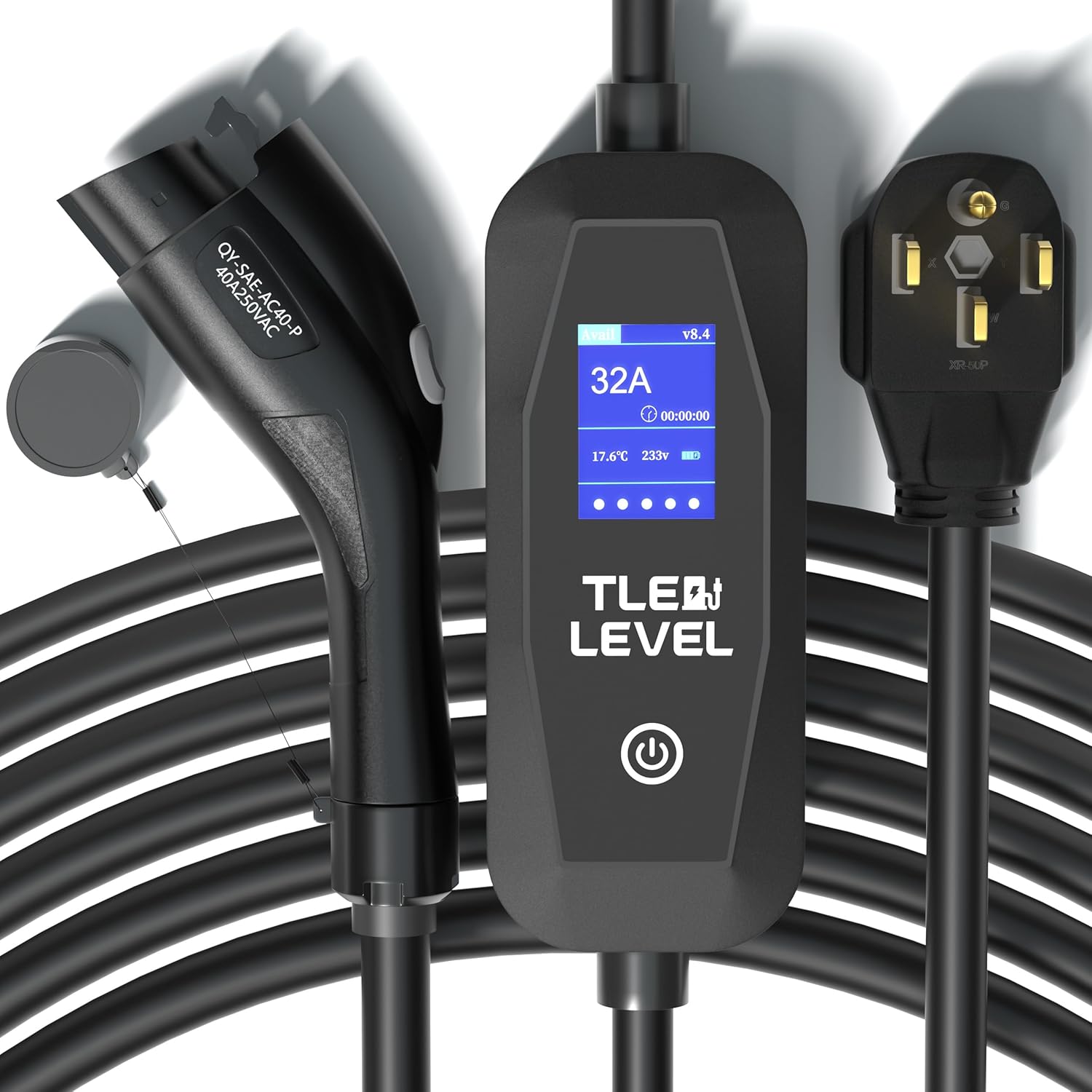
Not every portable charger is about travel; some are about power. A portable 40 Amp 9.6kW Level 2 EV charger on a NEMA 14-50 plug is the fastest portable class in North America, delivering near-wall-charger speed from any high-power outlet. This review focuses on what 9.6 kW actually means for your battery, the energy math, who genuinely needs this much portable power, and the verified units we recommend. For the reference unit, see this 40A 9.6kW portable on Amazon.
Power is the story here. At 240V and 40A, the unit pushes 9.6 kW into the car, adding roughly 30 or more miles of range per hour depending on the vehicle’s efficiency and on-board charger. That is the point at which portable charging stops being a compromise: a three-hour stop adds 90 miles, an overnight session empties a deficit completely. The NEMA 14-50 plug is the same one used by RV parks and high-power garage circuits, so the outlets that can feed this speed already exist in the places people travel.
Raw speed is only half the value; the other half is cost per mile. At roughly $0.16/kWh, 9.6 kW of charging costs about $1.54 per hour and delivers 30 miles, near five cents per mile. DC fast charging at $0.40/kWh or more costs three to five times that for the same mile. Over a year of mixed home and travel charging, the difference between portable-plus-pedestal and public fast charging runs into hundreds of dollars. Speed and savings point the same direction.
| Plug | Power | Range / hour |
|---|---|---|
| 5-15 (120V) | 1.9 kW | ~5 to 7 mi |
| 6-20 (240V, 16A) | 3.8 kW | ~11 to 13 mi |
| 14-50 (240V, 40A) | 9.6 kW | ~30+ mi |
The jump from 16A to 40A is the difference between an overnight compromise and a genuine fast-charge experience. For drivers who want portable gear without the speed penalty, this is the class to buy.
The 40A 9.6kW portable is the reference for pure power. The MACH 3 40A adds native Tesla NACS alongside J1772 for mixed households, and the 25ft version maximizes reach at the same output. All are certified mobile EVSE built around the same 14-50 foundation. For the wider field including lower-power options, see our best portable chargers roundup.
If your daily drive is 30 miles, a 16A unit does the job; if your schedule is unpredictable or heavy, 40A is the insurance policy.
| Option | Speed | Flexibility | Cost |
|---|---|---|---|
| 40A portable | ~30+ mi/hr | Travels with you | Hardware only |
| 48A wall charger | ~35 to 40 mi/hr | Fixed | Hardware + install |
A wall charger is marginally faster and tidier. The portable matches it closely and moves between home, cabin, and work. Many power users keep both: wall unit daily, portable for everything else.
At 9.6 kW the wiring does real work, so certification and circuit quality matter more than at 16A. Insist on UL or ETL listing, never extend with a household cord, and never force adapters between plug types. Keep the control box dry and off hot surfaces, and inspect the 14-50 plug for heat discoloration after long sessions. Our safety guide is worth a read before first use. Certified gear fails safe, but respect the amperage.
High-power sessions generate heat in the cable and control box. In summer, park the box in shade; if it throttles, that is protection, not failure. In winter, dry the connector and coil the cable loosely to avoid cracking the jacket. The duty cycle matters too: repeated back-to-back deep sessions run hotter than one nightly charge. A quality 40A portable handles this for years when treated with basic common sense.
The electricity cost is unchanged by speed: about $12 to $13 for a 75 kWh fill at $0.16/kWh. What changes is time and where you get that rate. A 40A portable makes home-rate energy available at RV parks, job sites, and friends’ houses, which is where the real savings hide. Our cost guide compares home versus public in detail.
A portable 40 Amp 9.6kW Level 2 charger is the performance end of mobile charging: wall-charger speed in a bag, at five cents a mile, anywhere a NEMA 14-50 exists. Our reference pick is the 40A 9.6kW portable, with the MACH 3 for Tesla-native households. If you need speed and flexibility in one device, this is the class that delivers both without compromise.
Talk to 40A portable owners and a pattern emerges. The happy ones have unpredictable schedules, two cars, or long commutes, and they value knowing a short window is still a useful window. The disappointed ones bought 40A for a 20-mile daily drive and never use the speed they paid for. The lesson is not that more power is bad, it is that power should match a real need. If your calendar includes surprise late nights and early departures, the headroom pays for itself the first week. If not, a 16A unit in the same bag costs less and does the same job.
Within the 40A class the differences are about use case rather than raw output. The reference 40A portable is the pure-power pick; the MACH 3 is for mixed Tesla and J1772 households; the display-equipped units add session monitoring for data-minded owners. All charge at the same 9.6 kW ceiling on a 14-50. Choose by the connector you need, the cable reach you want, and whether you will ever read a screen. The output is settled; the ergonomics are the real decision.
Lorem Ipsum is simply dummy text of the printing and typesetting industry
Complete guide to EV charger load management: dynamic load balancing, power sharing, static allocation. Wallbox, Autel, Emporia. Avoid panel upgrades...
Best Level 1 EV chargers for 120V outlet charging. Lectron dual-voltage, Tesla Mobile Connector, Emporia. Tips, costs, safety, when to...
Complete guide to scheduling EV charging: TOU rates, smart charger apps, solar surplus charging, cost savings calculator. Emporia, Wallbox, ChargePoint...




