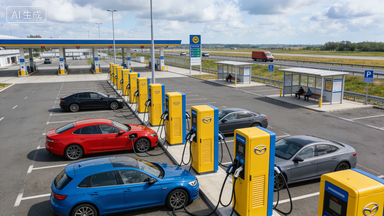
Public EV charging infrastructure plays a crucial role in long-distance travel, urban mobility, and commercial development. Below are the most important questions drivers and businesses ask about public stations, answered with technical depth and real-world accuracy.
Top-Rated Level 2 Home & Travel Chargers Public EV chargers complement home charging and provide several unique advantages:
• Fast charging capability: DC fast chargers (150–350 kW) add 150–200 miles in 15–25 minutes.
• Essential for long-distance travel: Enables intercity and interstate driving.
• Convenience for urban residents: Useful for people without private parking or garages.
• Reduces home electrical upgrades: Avoids panel upgrades or new 240-V circuits.
• Commercial locations offer bundled value: Malls, hotels, and restaurants often allow charging while shopping or dining.
Public stations will never replace home charging—but they greatly expand mobility and flexibility.
Public EV chargers communicate with your vehicle through standardized protocols (J1772, CCS, NACS). The station:
1. Authenticates payment or membership
2. Establishes communication with the EV battery management system
3. Regulates current based on station capability and vehicle limits
4. Monitors voltage, temperature, ground fault, and connector engagement
Level 2 stations supply AC power up to 19.2 kW. DC fast chargers bypass onboard AC chargers and deliver direct DC power to the battery, enabling rapid charging.
Profitability depends on location, utilization rate, energy pricing, and incentives. In general:
• DC fast chargers can be profitable in high-traffic areas (highways, malls, travel corridors).
• Level 2 chargers generate indirect revenue through customer attraction (e.g., retail dwell time).
• ROI typically ranges from 3–7 years when supported by incentives or rebates.
Profitability increases dramatically when businesses use chargers as a customer retention tool, not only as a paid utility.
Many hotels still lack chargers due to:
• Upfront installation cost ($2,000–$25,000 depending on type)
• Electrical service limitations requiring panel or transformer upgrades
• Lack of awareness of guest demand
• Not included in older hotel franchise standards
However, EV-friendly hotels enjoy higher occupancy, longer stays, and improved guest satisfaction—so adoption is increasing rapidly.
Payment models include:
• Mall-owned energy billing: mall pays electricity and earns charging revenue
• Network partnership: ChargePoint, EA, EVgo install/pay and share revenue
• Tenant co-funding: EV charging treated as an amenity increasing foot traffic
Many malls justify chargers through extended customer dwell time, which increases overall retail sales.
Yes. All Teslas in North America can use:
• Level 2 J1772 public chargers (with the Tesla → J1772 adapter)
• CCS fast chargers (with Tesla’s CCS1 adapter for compatible models)
• NACS public chargers, such as newer non-Tesla locations
Tesla’s charging ecosystem is highly compatible, making public charging flexible.
Electrify America operates one of the largest fast-charging networks in the U.S.
Common user experiences include:
• Extremely fast charging (150–350 kW)
• Modern stations with credit card or app payment
• High availability along interstates and metropolitan areas
• Occasional reliability issues (cable cooling faults, handshake failures, payment errors)
EA offers the best non-Tesla fast-charging coverage for long-distance EV travel, especially for CCS-equipped vehicles.
Lorem Ipsum is simply dummy text of the printing and typesetting industry
2026 Rivian R2 & R3 Home Charging Guide: Everything You Need to Know Affiliate Disclosure: EVChargerExperts is supported by its...
# 2026 Rivian R2 & R3 Home Charging Guide: Everything You Need to Know *Affiliate Disclosure: EVChargerExperts is supported by...
*Affiliate Disclosure: EVChargerExperts is supported by its audience. When you buy through links on our site, we may earn an...




