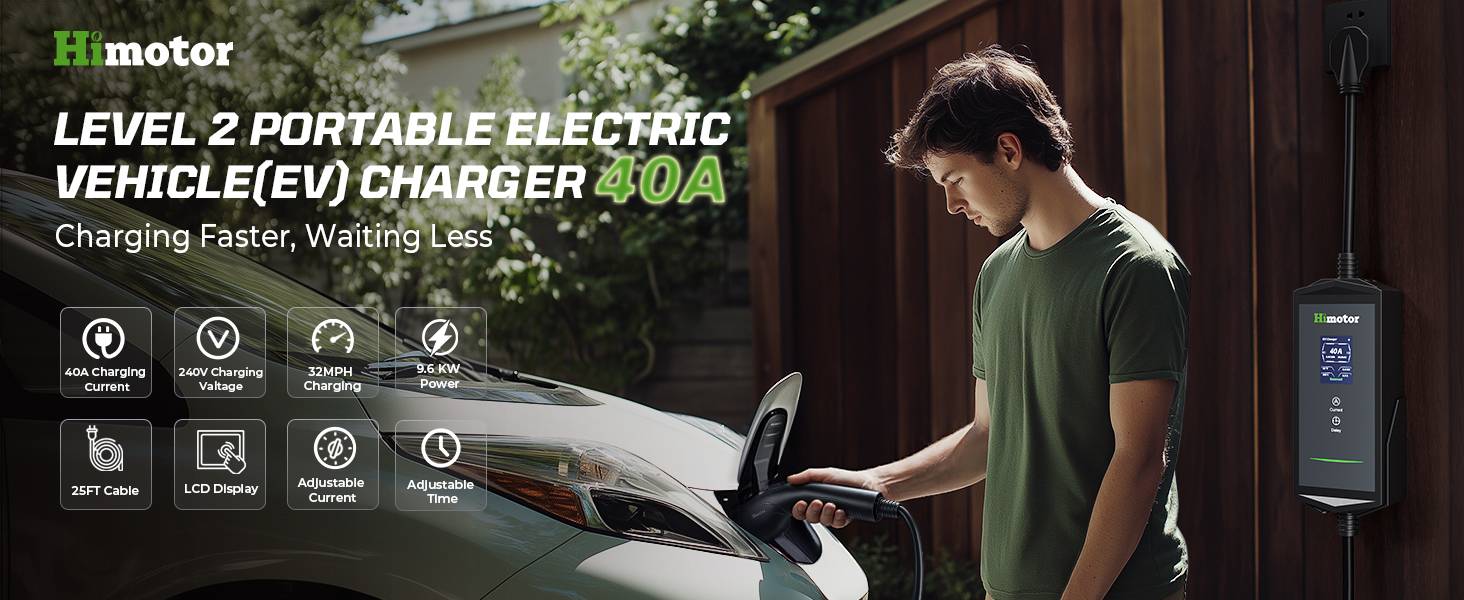
A 40A Tesla portable charger with a 2.4-inch LCD display, adjustable current, and a 25ft cable is the smart end of the portable market: it shows live session data on the unit itself, adapts its draw to the circuit, and charges a Tesla or any J1772 EV at up to 9.6 kW. This review focuses on what the display and adjustability actually add, the real speeds, who benefits from this class, and the verified alternatives. For the reference unit, see this 40A LCD portable on Amazon.
The headline feature is information at the plug. A clear 2.4-inch screen shows charging current, voltage, energy delivered, and session time without opening an app or walking back to the car. That visibility catches problems early: if the current is lower than expected, you see it before wasting an evening on a faulty outlet. For owners who like to know rather than trust, the display turns a black-box session into a monitored one. It is a small feature that quietly changes how you use the charger.
Alongside the screen, adjustable amperage lets the unit match whatever outlet it meets. Full 40A on a 14-50 for maximum speed, 24A or 16A on dryer-style or shared circuits, and lower settings for cautious wiring. This is the same flexibility that makes premium portables worth carrying: one device, every outlet, no guesswork. The 25ft cable complements it by reaching awkward parking spots where the nearest usable outlet is never beside the charge port.
| Setting | Power | Range / hour |
|---|---|---|
| 40A (14-50) | 9.6 kW | ~30+ mi |
| 24A | 5.7 kW | ~18 to 22 mi |
| 16A | 3.8 kW | ~11 to 13 mi |
The display makes the trade-off visible: dial down on a weak circuit and watch the session still complete safely overnight. That is the point of adjustability, not maximum speed at all costs.
The 40A LCD portable is the reference for display-driven charging. The MACH 3 40A covers dual-connector households with native NACS and J1772, while the 25ft portable maximizes reach. If you want maximum power from a simpler unit, the 40A 9.6kW portable skips the screen for a lower price. Our portable chargers roundup compares the whole field.
Units in this class typically ship with J1772 and often a native NACS connector or an adapter path, so a Tesla charges at full speed whether the end clicks directly into the port or through a certified J1772-to-NACS adapter. The display is car-agnostic: it reports what flows through the cable, not what the car thinks, which makes it equally useful for a mixed household with both Tesla and non-Tesla vehicles.
Buy certified (UL or ETL) hardware with ground-fault, over-current, over-temperature, and surge protection. The display is a monitoring tool, not a safety system; the certifications are. Keep the control box dry, off hot pavement, and inspect the cable jacket monthly. Our safety guide covers handling. A certified adjustable portable with a display is a genuinely reassuring way to charge on the road.
Portables earn their keep outdoors, so protect the electronics. Keep the display and control box out of standing water and direct sun, dry the connector before plugging in snow or rain, and coil the 25ft cable in loose loops. The screen itself is a small extra surface to care for; a soft cover or indoor storage keeps it readable for years. Treat it well and the unit survives seasons of travel.
Energy cost is unchanged at about $0.16/kWh, roughly $12 for a 75 kWh fill. The display simply shows you that cost accumulating in real time, which is surprisingly motivating for owners trying to shave utility bills. Pair scheduled off-peak charging with the live readout and the monthly math becomes transparent. Our cost guide breaks down home versus public rates.
A 40A Tesla portable with an LCD display and adjustable current is the thinking driver’s portable: fast at 9.6 kW, flexible across circuits, and transparent about every session. Our reference pick is the 40A LCD portable on Amazon. If you value knowing exactly what your charger is doing, this class is worth the modest premium over screen-less units. Match it to a proper 50A circuit and enjoy monitored, wall-charger speed anywhere.
The screen is most useful when you know what normal looks like. On a healthy 14-50 at 40A you should see near-full voltage and steady amperage; on a shared circuit a lower setting is the correct outcome, not a fault. If the numbers dip or fluctuate, the outlet or the connection deserves attention before the car does. Treat the display as a second opinion rather than an alarm: it confirms what you configured and flags what you did not expect. Owners who glance at it for the first minute of a session and then ignore it get all the benefit with none of the fuss.
A display-equipped portable makes an unusually good shared charger. In a household with two EVs taking turns on one outlet, the energy readout settles the quiet question of who charged what. In a family where one person is technical and the other just wants the car full, the screen gives the curious one something to check and the practical one nothing to do. It also travels well as the household’s single premium charger, since the amperage dial adapts to any outlet it meets. For shared and gifted use, the display earns its keep faster than any other smart feature.
Lorem Ipsum is simply dummy text of the printing and typesetting industry
Complete guide to EV charger load management: dynamic load balancing, power sharing, static allocation. Wallbox, Autel, Emporia. Avoid panel upgrades...
Best Level 1 EV chargers for 120V outlet charging. Lectron dual-voltage, Tesla Mobile Connector, Emporia. Tips, costs, safety, when to...
Complete guide to scheduling EV charging: TOU rates, smart charger apps, solar surplus charging, cost savings calculator. Emporia, Wallbox, ChargePoint...




