
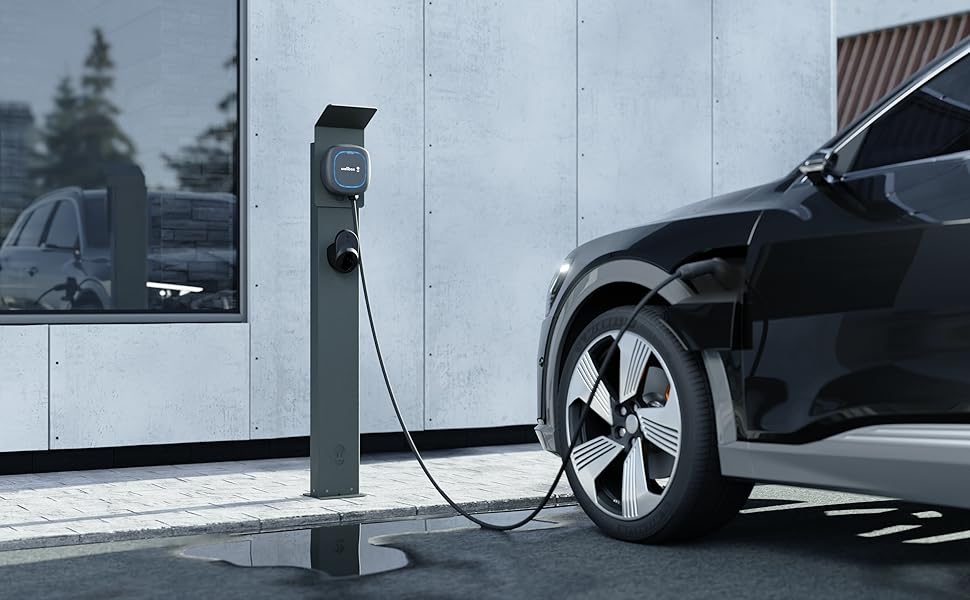
The Wallbox Pulsar Plus 48A is the most compact 48-amp Level 2 EV charger on the market, delivering 11.5 kW of charging power in a housing smaller than a lunchbox. Its standout features — Power Boost dynamic load management, power sharing across up to 10 units, and NEMA Type 4 outdoor rating — make it the best smart charger for multi-EV households and homes with limited electrical capacity. However, its 3.4-star Amazon rating (driven by early firmware bugs now largely resolved) and hardwired-only installation requirement mean it’s not for everyone.
Best for: Multi-EV households, homes with 100A or 200A service, smart home enthusiasts, and outdoor installations where compact size matters.
Not ideal for: Budget buyers under $400, renters who need a plug-in charger, or those who want the absolute highest Amazon customer satisfaction rating.
The Wallbox Pulsar Plus has been one of the most talked-about home EV chargers since its launch, and for good reason. Wallbox — a Spanish EV charging company that has expanded aggressively into the North American market — packed an impressive amount of technology into what is genuinely the smallest 48-amp charger you can buy. At 7.8″ x 7.9″ x 3.9″, it’s roughly the size of a lunchbox, yet it delivers 11.5 kW of charging power, enough to add 37 miles of range per hour to most EVs.
After analyzing specifications, expert reviews, user feedback from Amazon and Reddit, and comparing it against the top 5 home EV chargers we tested, here’s our comprehensive assessment.
This is the Pulsar Plus’s killer feature. Power Boost dynamically adjusts the charger’s amperage in real-time based on your home’s total electrical load. If your HVAC kicks on, the charger automatically reduces its draw to prevent tripping your main breaker. When the load decreases, it ramps back up. This is particularly valuable for homes with 100A or 200A electrical service where a 48A charger (which requires a 60A dedicated circuit) would otherwise push the panel to its limit.
No other home charger in this price range offers comparable dynamic load management. The ChargePoint Home Flex and Emporia L2 both charge at a fixed rate unless you manually adjust the amperage in their apps. For households running AC, an electric oven, and a charger simultaneously, Power Boost alone could be the reason to choose Wallbox.
If you have two (or more) EVs, the Pulsar Plus can share power across up to 10 units on the same circuit. This means you can install two chargers on a single 60A circuit, and they’ll intelligently split the available power — each getting 24A when both are charging, or one getting the full 48A when only one is plugged in. No additional hardware or load balancer is needed; the chargers communicate directly with each other.
For comparison, achieving similar functionality with ChargePoint or Emporia would require a separate load management device costing $200-$400 extra. The Pulsar Plus includes this capability built-in.
At 7.8″ x 7.9″ x 3.9″, the Pulsar Plus is significantly smaller than competitors. The Emporia L2 is 9.3″ x 7.1″ x 3.1″, and the ChargePoint Home Flex is 11.4″ x 7.3″ x 3.4″. If you’re installing on a garage wall with limited space, or mounting outdoors where aesthetics matter, the Pulsar Plus is the clear winner.
The compact size also makes installation easier in tight spots. The unit includes a wall bracket and mounting hardware, and the hardwired connection means no bulky NEMA plug protruding from the wall.
NEMA Type 4 is a higher outdoor rating than most competitors offer. It means the enclosure is protected against windblown dust and rain, splashing water, hose-directed water, and damage from external ice formation. For context:
If you’re installing outdoors in an exposed location without a cover, the Pulsar Plus is one of only three chargers we recommend (along with Emporia and Grizzl-E).
The myWallbox app (available for iOS and Android) provides:
The app also integrates with Amazon Alexa and Google Assistant for voice commands. You can ask “Alexa, how much did my EV charge last night?” and get a spoken response — a feature that ChargePoint also offers but Emporia lacks.
One important note: the Pulsar Plus has onboard intelligence, meaning your charging schedules are stored in the charger itself. If your Wi-Fi goes down, your scheduled charging continues working. This is a significant advantage over chargers that require constant internet connectivity to function properly.
| Electric Vehicle | Battery Size | 0-100% at 48A (11.5 kW) | Miles of Range/Hour |
|---|---|---|---|
| Tesla Model Y LR | 75 kWh | ~6.5 hours | ~37 miles |
| Tesla Model 3 LR | 75 kWh | ~6.5 hours | ~37 miles |
| Ford Mustang Mach-E | 91 kWh | ~8 hours | ~30 miles |
| Chevy Bolt EUV | 65 kWh | ~5.5 hours | ~25 miles |
| Rivian R1T | 135 kWh | ~12 hours | ~37 miles |
| Hyundai Ioniq 5 | 77.4 kWh | ~7 hours | ~37 miles |
The 48A model delivers up to 37 miles of range per hour — fast enough to fully charge most EVs overnight. At this rate, a Tesla Model Y with a 75 kWh battery goes from empty to full in about 6.5 hours. Even the large 135 kWh battery in a Rivian R1T will top up in about 12 hours.
For comparison, the 40A version of the Pulsar Plus delivers 9.6 kW (~30 miles/hour) and requires only a 50A circuit. It costs $399 vs. $449 for the 48A. If your electrical panel can’t support a 60A circuit, the 40A is the better choice.
| Feature | Wallbox Pulsar Plus 48A | Emporia L2 48A | ChargePoint Home Flex |
|---|---|---|---|
| Max Amperage | 48A | 48A | 50A |
| Max Power | 11.5 kW | 11.5 kW | 12 kW |
| Price Range | ~$449 | ~$399 | ~$649 |
| Installation | Hardwired only | NEMA 14-50 or Hardwired | NEMA 14-50 or Hardwired |
| Outdoor Rating | NEMA Type 4 | NEMA Type 4 | NEMA 3R |
| Cable Length | 25 ft | 24 ft | 23 ft |
| Connectivity | Wi-Fi + Bluetooth | Wi-Fi | Wi-Fi |
| Voice Control | Alexa + Google Home | No | Alexa + Google Home |
| Power Sharing | Yes (up to 10 units) | No | No |
| Power Boost | Yes (load management) | No | No |
| Energy Monitoring | Real-time in app | Yes (Emporia app) | Yes (ChargePoint app) |
| Warranty | 3 years | 3 years | 3 years |
| UL Certified | Yes (UL 2594, 2231) | Yes | Yes (Energy Star) |
| Dimensions | 7.8″ x 7.9″ x 3.9″ | 9.3″ x 7.1″ x 3.1″ | 11.4″ x 7.3″ x 3.4″ |
| Amazon Rating | 3.4 stars (14 reviews) | 4.7 stars (3,800+ reviews) | 4.6 stars (2,900+ reviews) |
The Pulsar Plus currently sits at 3.4 stars across 14 reviews on Amazon — significantly lower than the Emporia (4.7 stars, 3,800+ reviews) or ChargePoint (4.6 stars, 2,900+ reviews). However, context matters: the low rating is driven primarily by early firmware issues (app connectivity problems, charging interruptions) that Wallbox has largely addressed through OTA updates. Recent reviews from 2025-2026 are notably more positive, but Amazon’s aggregate score hasn’t caught up.
On Reddit’s r/electricvehicles and r/evcharging, user sentiment toward the Pulsar Plus is more favorable, with most complaints being about the app UX rather than the hardware itself. The hardware is widely regarded as excellent; the software experience has been the weak point.
The 48A version requires hardwired installation — you can’t just plug it into a NEMA 14-50 outlet. This means you’ll need an electrician to wire it directly to your panel, which adds $200-$500 to the total cost depending on your setup. The 40A version is available with a NEMA 14-50 plug, making it a better option for renters or those who want an easier DIY installation.
If you need a plug-in charger, consider the Emporia L2 (NEMA 14-50 plug, 48A) or the budget chargers under $400 we’ve reviewed.
While the myWallbox app has improved significantly, it still lags behind the ChargePoint app in terms of polish and reliability. Common complaints include:
That said, Wallbox has been actively pushing firmware updates, and the most recent versions (early 2026) have addressed many of the connectivity issues reported in 2024-2025 reviews.
| Installation Scenario | Estimated Cost | Timeline |
|---|---|---|
| Panel within 15ft, simple run | $200-$400 | 2-4 hours |
| Panel 15-50ft, through drywall | $400-$700 | 3-6 hours |
| Outdoor mount, trenching required | $700-$1,500 | 1-2 days |
| Panel upgrade needed (100A→200A) | $2,000-$4,500 | 1-2 days |
The Wallbox Pulsar Plus qualifies for the 30% Federal Tax Credit (IRC 30C), which covers 30% of the cost of the charger and installation, up to $1,000. This effectively reduces the cost of the charger from ~$449 to ~$314 after the tax credit. Many states and utility companies offer additional rebates of $200-$1,500 on top of the federal credit.
For a complete guide to installation costs, permits, and tax credits, see our Level 2 EV Charger Installation Guide.
If you have two or more EVs, the Pulsar Plus’s built-in power sharing is a game-changer. Instead of installing two separate circuits (which would cost $800-$1,500 in electrical work), you can install two Pulsar Plus units on a single 60A circuit. The chargers automatically balance the load, and Power Boost ensures your home’s other electrical needs aren’t compromised.
If you already have Alexa or Google Home running your lights, thermostat, and security, the Pulsar Plus fits naturally into your ecosystem. Voice commands for charging status and the ability to integrate with other smart home routines (e.g., “only charge when solar production exceeds 3kW“) make it the most connected charger available.
If your home has 100A service and you’re worried about adding a 48A charger, Power Boost makes the Pulsar Plus the safest choice. It will never trip your main breaker because it actively monitors total home load and adjusts accordingly.
| Pros |
|---|
|
| Cons |
|
The Wallbox Pulsar Plus 48A is a premium smart charger for tech-savvy EV owners who want the most compact design, dynamic load management, and multi-unit power sharing. Its unique Power Boost feature genuinely sets it apart from every competitor at this price point. If you have a multi-EV household, limited electrical capacity, or want the smallest possible charger on your garage wall, the Pulsar Plus is an excellent choice.
However, if you just want a reliable charger with the best customer reviews and the easiest installation, the Emporia L2 at $399 with 4.7 stars is the safer bet. The Pulsar Plus trades some polish and simplicity for features that most owners will appreciate but not everyone needs.
Our rating: 4.0/5 — Excellent hardware with innovative features, held back only by the app experience and lower social proof on Amazon.
Wondering how the Pulsar Plus compares to the Tesla Wall Connector? See our Tesla Wall Connector review for a head-to-head comparison.
Related: Looking for portable charging options? Check out our complete guide to the best portable EV chargers for detailed recommendations.
Related Reading:
See also: Curious about charging costs? See our complete EV charging cost guide for detailed savings calculations.
Yes, if you want a compact smart charger with power sharing. The Pulsar Plus delivers up to 40A (48A hardwired) in one-third the volume of typical chargers, and its Power Boost feature dynamically manages home energy loads. It costs more than basic chargers but undercuts premium brands like ChargePoint while offering similar smart features.
Yes. The Pulsar Plus integrates with both Amazon Alexa and Google Assistant for voice control, plus IFTTT for home automation routines. The myWallbox app handles scheduling, amperage adjustment, and charging statistics over WiFi or Bluetooth.
Yes — power sharing is the Pulsar Plus’s signature feature. Up to 40 units can share available capacity on a single electrical service, making it popular for duplexes and small multifamily installations. Each unit automatically receives its share of available amperage.
Lorem Ipsum is simply dummy text of the printing and typesetting industry
Complete guide to EV charger load management: dynamic load balancing, power sharing, static allocation. Wallbox, Autel, Emporia. Avoid panel upgrades...
Best Level 1 EV chargers for 120V outlet charging. Lectron dual-voltage, Tesla Mobile Connector, Emporia. Tips, costs, safety, when to...
Complete guide to scheduling EV charging: TOU rates, smart charger apps, solar surplus charging, cost savings calculator. Emporia, Wallbox, ChargePoint...




3 thoughts on “Wallbox Pulsar Plus 48A Review 2026: The Smartest Compact EV Charger?”